Staff Spotlight: Lisa

Connected to Saklan way back when it was named Carden School. Lover of the Matterhorn at Disneyland. Excited about innovative math instruction. Served as not only a teacher but also the Saklan PA President and Chair for the Board of Trustees. Can you guess who we are highlighting as this month’s Staff Spotlight? Our third-grade teacher, Lisa Rokas, has worn many hats here at Saklan. Read on to learn more about her decades-long journey at The Saklan School.

How did you first hear about the Saklan School?

I have a long history with Saklan. I grew up in Orinda and attended Miramonte High School. My brother, who is 6 years younger than me, attended Saklan (which was named Carden School at the time). Once I had my driver’s license I used to drive him to and from school. Fast forward to when my son was in kindergarten, I decided to look for alternatives to our local public school and my mom suggested I look at Saklan. My son joined in first grade back in 2004, and my daughter joined the following year in kindergarten. I have been connected to the school ever since.
What about the Saklan community has kept you so invested and engaged in different ways over the years? 

I have worn many hats here at Saklan. When my kids were students at Saklan I joined the Parent Association, where I held many roles, including auction chair and PA President. I started on the Board of Trustees as the Parent Association representative and eventually served as Board Chair for a number of years. I made lifelong friends with many of my fellow board members on both the board of trustees and parent association, as well as many strong friendships with Saklan faculty and staff. One memorable moment includes dressing up as pink cotton candy ladies for the end-of-year carnival. When my daughter graduated from Saklan in 2014, I couldn’t imagine saying goodbye to a place where I had been so connected for so many years. I decided to go back to teaching, my first profession before having kids. I started teaching at Saklan in the fall of 2014 and have had the honor of teaching here ever since. Saklan is truly a part of my family and my home away from home.

What has been your favorite project based learning unit in your time here and why?

My favorite project based learning unit each year has been our third grade Saklan/ Bay Miwok Unit where we learn about the local indigenous peoples from the Moraga Valley. Our driving question is “How can we show respect to the people whose ancestral land our school is on?” I especially love this project because each year the third graders have found different ways to answer our driving question in meaningful ways; such as writing a land acknowledgement and creating murals and posters including traditional language and symbols representing Saklan culture. This year students researched indigenous plants we hope to plant on our campus. We have had the opportunity to work closely with Vincent Medina and Louis Trevino, the cofounders of Cafe Ohlone who both have Ohlone heritage and who are focused on sustaining their traditional Ohlone culture. The most important lesson the students learn is that Saklan/Bay Miwok/ Ohlone people are still here and their culture and traditions are still being practiced and celebrated.

We know your love for Disneyland runs deep, what is your favorite season to visit the park and the snack and/or ride you look forward to most?

I do love Disneyland! It is one of my absolute favorite places! I enjoy visiting anytime of the year, but my favorite time to visit is during November or December when the holiday decorations are up. It is so festive! I especially love watching Fantasmic on the Rivers of America and also the fireworks from Main Street! My favorite ride ever since I was kid is still the Matterhorn Bobsleds, and my favorite snacks at Disneyland are definitely their fresh-popped buttery popcorn or churros from the snack carts. Thankfully, I have passed on my love of Disneyland to my kids so that they still enjoy going to the park with me.

Life as a Pioneer Child

The third graders recently took a journey back in time to 1888, stepping into the shoes of pioneer children at the historic Tassajara One-Room Schoolhouse. Dressed in their finest pioneer attire and carrying lunches in baskets or kerchiefs tied to sticks, they experienced a school day just as children did over 130 years ago—when Grover Cleveland was president and the U.S. had only 38 states!

During their visit, students read from McGuffey Readers (published in 1879), practiced math on slate boards with chalk, and even tried their hand at cursive writing using quill pens dipped in ink. It was a hands-on, immersive glimpse into the past that brought history to life in an engaging way! 

Recess was just as much fun as the school day itself! The third graders jumped rope, walked on cans and wooden stilts, and even sang songs while playing instruments popular in the 1800s. They also explored inventions and news articles from the time, gaining a deeper understanding of daily life in 1888. By the end of the day, they all agreed—school was definitely fun in the past!

#SaklanHandsOn #SaklanFieldExperience

Communicating Through Color

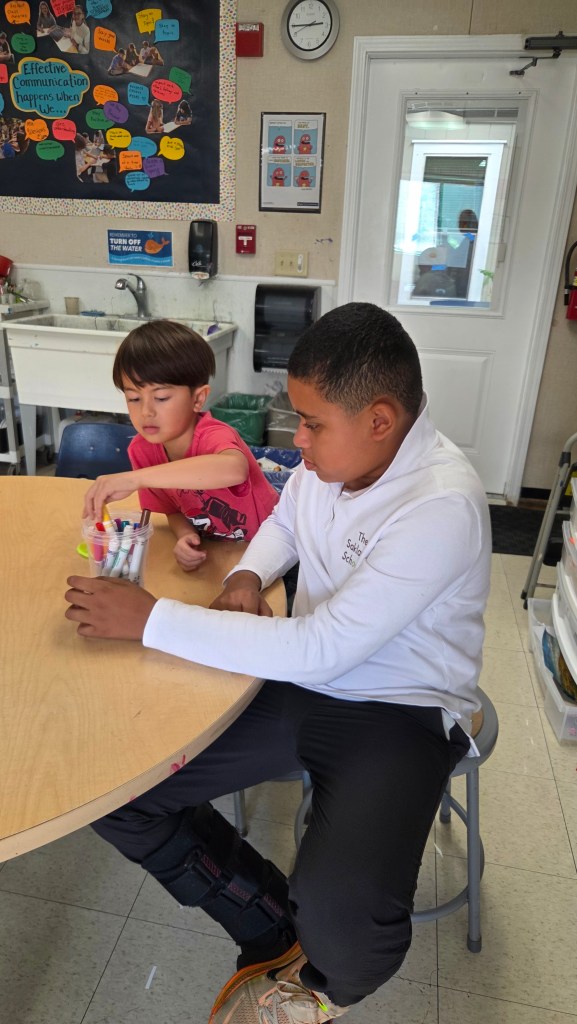
One of the most special elements of Saklan Project-Based Learning is the ways in which annual units take on different elements each year. For the last three years 2nd and 3rd grade students have designed the backdrop for our spring concert at the Lesher Center as part of a PBL unit on color and communication. This unit centers on the driving question: How can we understand the art world to design a backdrop that communicates “garden?”

This year there has been an intentional focus on one particular Studio Habit of Mind: Understanding the Art World. This studio habit, one of eight developed by the researchers at Project Zero, focuses on the study of art history and contemporary practices to learn how to act as an artist in collaboration with other artists in broader society.

The unit began with students sharing their own experiences of gardens. This process activated their prior knowledge and began to elicit ideas, feelings, and questions connected to the concert theme. Next, they completed a whole class brainstorm of ideas, colors, experiences, feelings, and connections to the driving question. This work helped guide the decisions about which artists students would focus their learning on as they worked toward the design and creation of the concert backdrop.

The unit then moved on to explore artists whose work focuses on gardens, nature, and tending to the environment. Made with charcoal scavenged from the scorched earth after a wildfire, Emily Gui’s drawings of wild grasses that emerged after the fire, connected to the 3rd graders’ research on native plants earlier this year. It was also a jumping off point to help expand the students’ definition of what a garden may mean to different peoples. They compared drought maps to the work of Saif Azzuz, which often focuses on the importance of tending the California landscape through the Indigenous wisdom of cultural burns and the varied medicinal uses of native plants, as seen in his recent installation at Stanford Research Park. Finally, students considered the impact of color, and what happens to our interpretation of artworks when color is removed using works by Kim Champion. It struck students that when the color was removed from her art, often much of the meaning was lost and the figures became harder to identify.

Visiting SFMOMA as part of this PBL unit was a highlight for our second graders. This opportunity to engage with large works in a museum space gave students a chance to observe a variety of ways artists convey the theme of garden. They explored many different types of works and interpretations of our theme.

After exploring different artists’ interpretations of garden, students reflected on the feelings and connections to the theme that they wanted to express through their backdrop art. Three distinct groups emerged. One group most associated gardens with the feelings of excitement and joy, another with a sense of awe for life, and a third associated gardens with calm. Each feeling group identified colors to communicate those feelings using their growing understanding of the art world. 

Knowing how colors impact each other when side by side and gaining an understanding of the need for balance between colors were the next key elements to successful communication through color that students began to explore. Color mixing recipes were iterated on to figure out how to mix just the right tint, shade, or hue of the desired colors.

Additionally two small groups considered the ways line and shape can help us communicate our theme. One group felt a sense of curiosity when considering the theme of “garden” and worked to create a line language for our backdrop. Another considered the connection between the theme of “garden” and fruits and vegetables. 

At the concert, look for the line and shape language they developed among the beautiful colors the students have so carefully selected and balanced. You may spot many ovals, circles, and textures that mimic overlapping yerba buena leaves, curved lines like the edges of a valley oak leaf and its branches, or the texture of corn on the cob.

The students are now preparing the backdrop canvases by applying a base coat and will begin painting their version of “garden” very soon. We are excited to unveil the finished product at the All-School Concert on Friday, March 21st. See you there!

#SaklanPBL #SaklanCreative

Adventure in Space

The Hoot Owls have taken on a new inquiry topic: Space! Space is something that the class was very curious about, and just like any new inquiry, they started by asking questions. Amongst their many wonders, the Hoot Owls shared:

  • “How come there is no gravity in space?”
  • “Why is there an eclipse?” 
  • “What are the little red rovers on different planets?” 

The class read Moon! Earth’s Best Friend by Stacy McAnulty, in which they discovered that the moon has different phases. Next, to address one of the student’s questions, “Why is there a moon in space?” the class watched a video about the formation of the moon. The Hoot Owls then created moon representations to showcase what they learned about the moon phases. 

Since the Hoot Owls were very curious about gravity, the class watched a video that taught them that gravity is a strong force that pulls things toward the center. They learned that gravity is what keeps people on Earth and why things fall to the ground. 

Next, the class read Sun! One in a Billion by Stacy McAnulty, which taught them that the sun is a dwarf star that gives us light. From Earth! My First 4.54 Billion Years by Stacy McAnulty, the class learned that Earth started as a big flaming ball of hot molten lava, and then it cooled with long periods of rain until it formed land. The Hoot Owls also learned about the four parts that make up the Earth: the crust, mantle, outer core, and inner core. They were amazed to learn that the sun’s gravitational pull keeps the Earth orbiting around the sun.

To reflect on what they learned, the class made Earth representations by looking at a globe and water-coloring what they saw. They are also working to create a representation of the solar system in our classroom.

Moving Up Day Enthusiasm

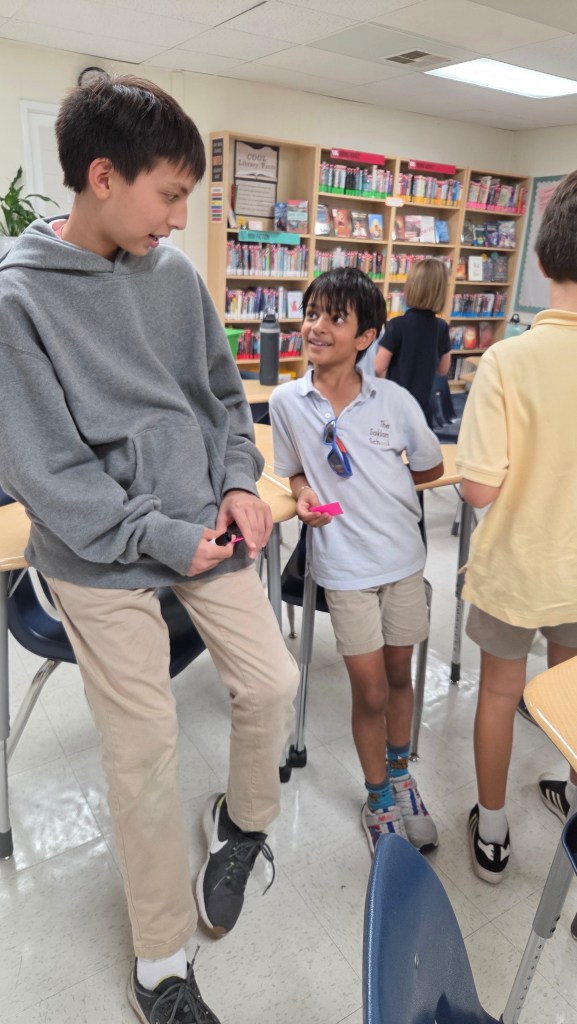
On Thursday morning, all Saklan students participated in Moving Up Day. Preschool – 5th graders had the opportunity to move up to the classroom of their rising grade and spend time with the teacher, learning about what the next year holds and getting to know the teacher better. The 6th, 7th, and 8th-grade students helped host 5th graders on the middle school side of campus and show them what a day in the life of a middle schooler is like. The students and teachers alike were buzzing with excitement!

This annual tradition allows the students to get a snapshot of what next year will hold. The teachers planned special activities that highlighted their grade level and enjoyed getting to know their rising students a little better. Morning meeting activities, awkward games, questions, book readings, optical illusions, classroom scavenger hunts, and enthusiasm for next year filled the classrooms! If you know a child who “moved up” on Thursday, please ask them all about it. They will likely have something enthusiastic to share!

Celebrating Lunar New Year

Saklan students celebrated Lunar New Year with some special activities on Wednesday. Lunar New Year, which celebrates the start of the lunisolar Chinese calendar, is celebrated in China, Vietnam, Korea, Malaysia, and Singapore, among other countries.

Preschool students welcomed two guest experts to share about Lunar New Year. Samantha, an Owlet parent, read a book to the class and shared red envelopes with them. Sharon, an Owlet grandparent, shared Lunar New Year traditions that take place in China, told the story of The Great Race, and shared tangerines with the students. The Owlets also enjoyed making snake paper lanterns, Lunar New Year yoga, and listening to traditional Chinese music.

Pre-K students celebrated by welcoming Heidi, a Hoot Owl mom, into their class. Heidi shared that Lunar New Year is based on the Moon instead of the sun and talked about the Chinese word for fortune, 福, and its importance. Heidi shared pictures of her children wearing special Lunar New Year outfits and then treated the class to some bao filled with custard.

Maggie also taught the Hoot Owls about her family’s Lunar New Year traditions, including cleaning their homes and putting up Chinese sayings with good wishes for the new year. The Pre-K students enjoyed watching a video of a lion dance, as well as talking about and receiving red envelopes.

To help with the campus celebrations, the 5th graders put together a dragon which Peta hung on the pergola to welcome students to campus on Wednesday. The fifth graders also made lanterns and dragon drawings.

In humanities class, Christina shared some of her family traditions with the 6th graders, including the tradition of eating tangerines, which are believed to bring good fortune, and of giving red envelopes with money in them as a symbol of good luck. She also shared the proper etiquette for giving and receiving the red envelopes to show respect. The 6th graders also talked about the importance of the Chinese word for fortune and then learned how to write it.

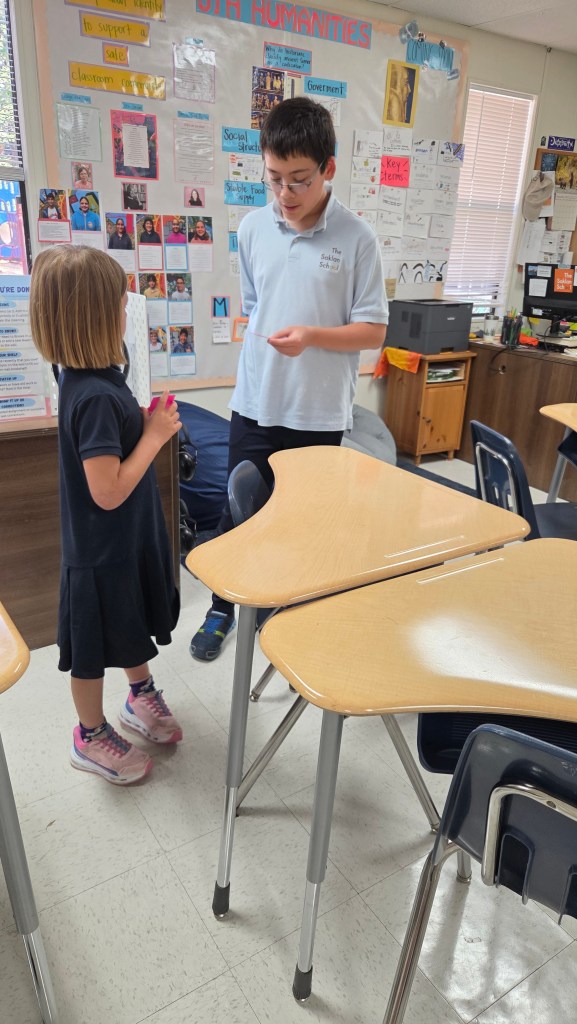
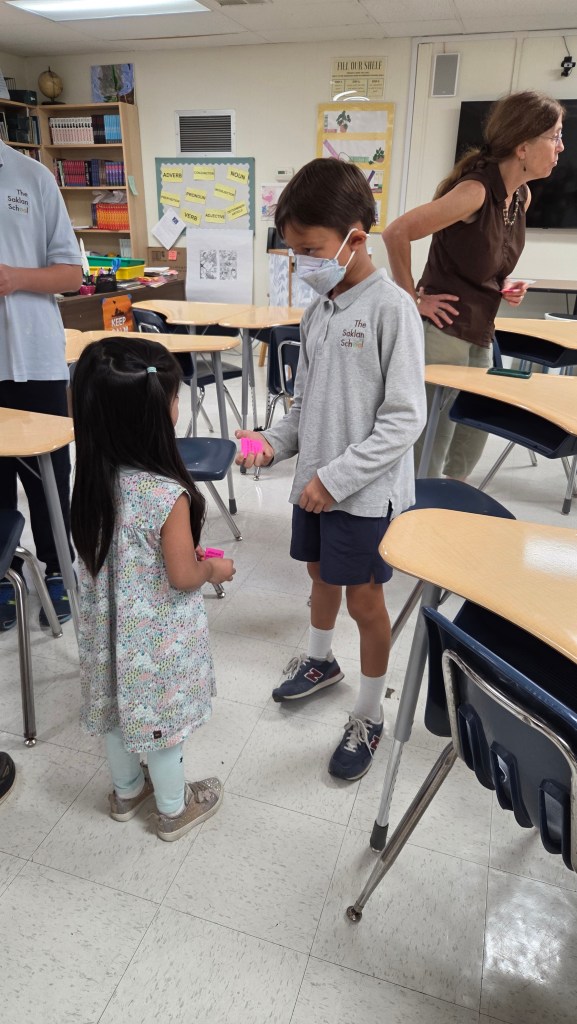
The 6th graders then took their newly acquired skills over to the Hoot Owl classroom, where they taught the Hoot Owls how to write the word for fortune with brushes and ink.

May the Year of the Snake be prosperous for all!

#SaklanCommunity

Ecosystems and Adaptations

In science, the 6th graders recently explored Earth’s biomes. Working in pairs, they created educational slideshows to teach their classmates about our planet’s incredible variety of ecosystems. Afterward, they dove deeper into the topic by examining how organisms adapt to survive in diverse environments. This culminated in an engaging “Adaptation Auction,” focusing on two contrasting ecosystems: the ocean and the desert.

The 6th graders explored the stark differences between these ecosystems, identifying particularly beneficial adaptations in each. The desert’s unique ability to preserve species, culture, and history—due to its dry climate, fewer large scavengers, and minimal decomposers—sparked fascinating discussions. To bring this concept to life, students mummified apples in class! They created a narin mixture of salt and baking soda to act as our drying agent. Students then carved a face into an apple and let it sit in the narin mixture for a week. They observed how the drying agent caused noticeable changes in size, texture, and weight after just one week.

Next, the students moved on to studying the relationships between species within ecosystems, such as mutualism, parasitism, and commensalism. They created comics that illustrate these interactions in real-world scenarios to demonstrate their understanding. Below are examples of their creative work.

#SaklanHandsOn #SaklanCreativity

Head’s Corner: Teaching How to Think, Not What to Think

As someone who has taught history for a good portion of my professional life, I’ve always felt that how history is taught in the U.S. is a disservice to students. There is an emphasis on students “knowing” the country’s entire history, without understanding it. The curriculum will lean into a simplified version of history that leads students to a particular perspective. Rarely does history teaching slow down and ask students to wrestle with both sides of an issue and develop their own opinions. (Think Moraga Police Chief King reading All American Boys along with our eighth-grade class and then coming in to discuss his take on the novel.)

The other sin of how we approach history teaching in the U.S. is one of omission. We simplify complicated stories into fables that are easy to digest. For example, unpack the popular myth of Rosa Parks and her famous refusal to give up her seat on a Montgomery bus – the story that a meek, tired seamstress was too exhausted to walk to the back of the bus and accidentally started a movement that changed civil rights. There is a romanticism to that story, but it is wrong.

In reality, Rosa Parks had been an activist fighting for racial justice for decades before her bus stand. Though described as “quiet” in most of the obituaries that ran after her 2005 death, she was anything but.

The fable of Rosa Parks and the civil rights movement of the time betrays the reality, pain, and sacrifice of those who fight the good fight. It ignores how resistant Americans worked to challenge the status quo. It is also a disservice to the country.

As educators, we owe it to society to examine the fables and myths we have heard and those we have perpetuated – from Christopher Columbus to American Exceptionalism. We also owe it to our students to help them know less but understand more and reach their own conclusions, not ours.

Peace,

David

Successful Community Spaces

As part of their Community Spaces Project Based Learning unit, 7th graders recently analyzed, brainstormed, collaborated and categorized to answer the focus question: What makes a community space successful and sustainable?

First, each student wrote a paper analyzing the successful and sustainable features of one space or structure in the Maya, Aztec/Mexica, or Inka civilizations. The spaces and structures they studied included the construction and urban design of Tenochtitlán, temples, marketplaces, ballcourts, observatories, homes, and palaces. 

Next, the class brainstormed successful features of the places they visited during field experiences: Moraga Commons, the Wellness Center at Los Perales Elementary School in Moraga, the Oakland Museum of California, and Temple Hill in Oakland. The students also learned about contemporary sustainable low-rise buildings designed by Japanese architect Kengo Kuma, such as the National Stadium built for the 2020 Tokyo Olympics. 

After they generated lists of the successful features of all of these spaces and structures, the students worked in small groups to place these features into categories. They used the below visual representation as a model. Next, the class narrowed down their successful space criteria into six categories. Working in groups, the class collaborated to create their own version of the diagram (click the arrows below to see their version).

To conclude the unit, the 7th graders applied the success criteria they developed to propose improvements to the existing Saklan School campus or a redesigned and rebuilt Saklan campus. The students presented their suggested improvements to members of the Saklan Board of Trustees and the administrative team on Thursday and Friday of this week.

To learn more about their campus improvement suggestions, please join us for CLAS next week, on Friday, January 31st, when the 7th graders will share an overview of their project with the community.

#SaklanPBL

Inspiring Author Visit

Our lower school students were recently thrilled to welcome author Traci Huahn to Saklan for an inspiring visit centered around her book, Mamie Tape Fights to Go to School. During the 45-minute session, students enjoyed a captivating read-aloud of the book, learned about the historical significance of Mamie Tape’s fight for school desegregation during the era of the Chinese Exclusion Act, and explored how this moment in history connects to the broader civil rights movement.

Ms. Huahn also shared her journey as an author, offering an inside look at the research, writing, revising, and publishing process. Students were delighted by a special video message from the book’s illustrator, Michelle Jing Chan, who revealed her creative process and behind-the-scenes details.

The visit sparked engaging discussions about bravery, standing up for your rights, and the power of storytelling. Students asked thoughtful questions during the Q&A, deepening their understanding of the themes and lessons in the book.