Staff Spotlight: Maggie

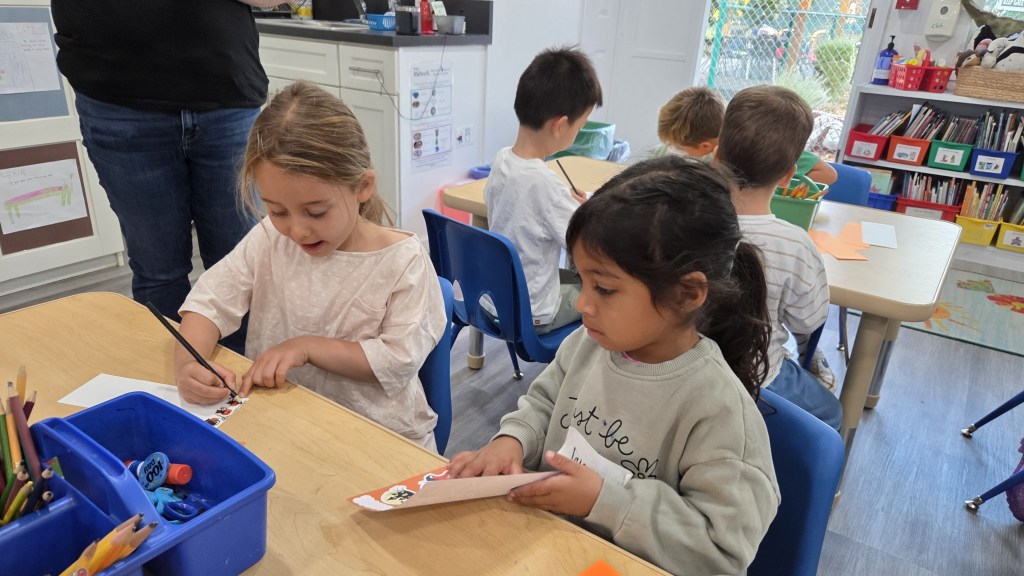
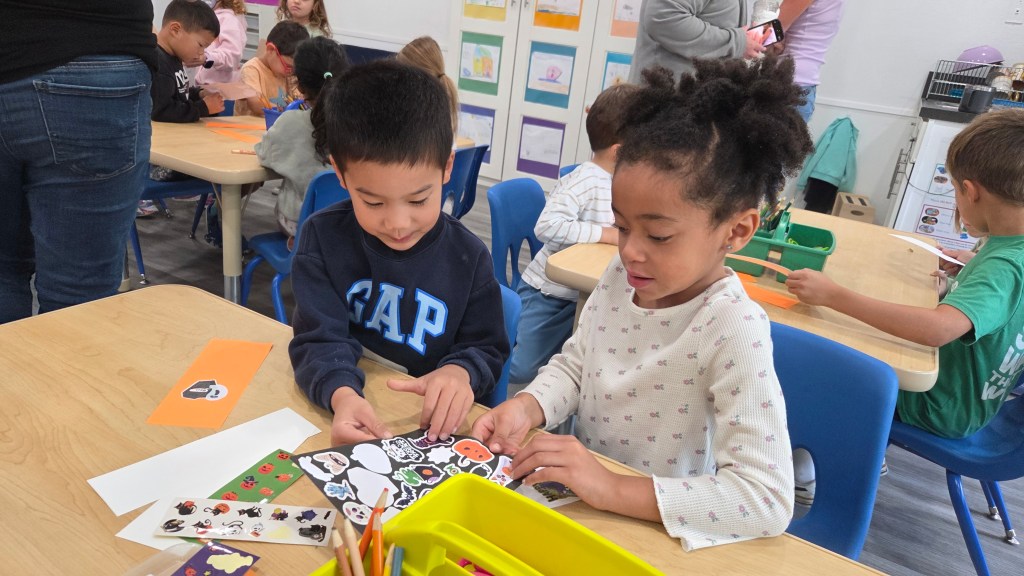
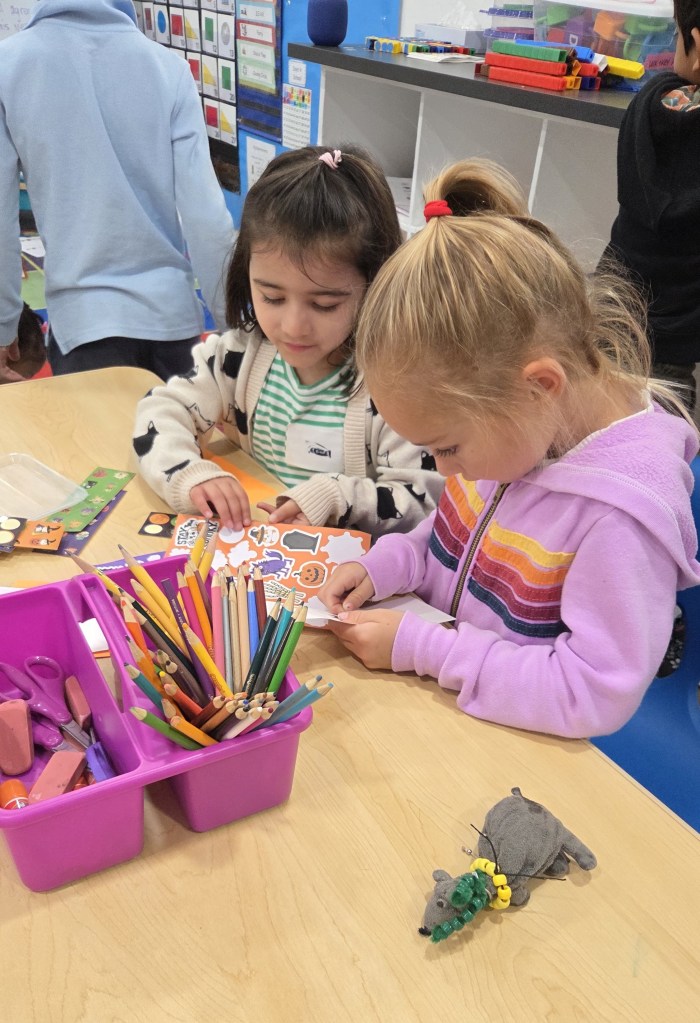
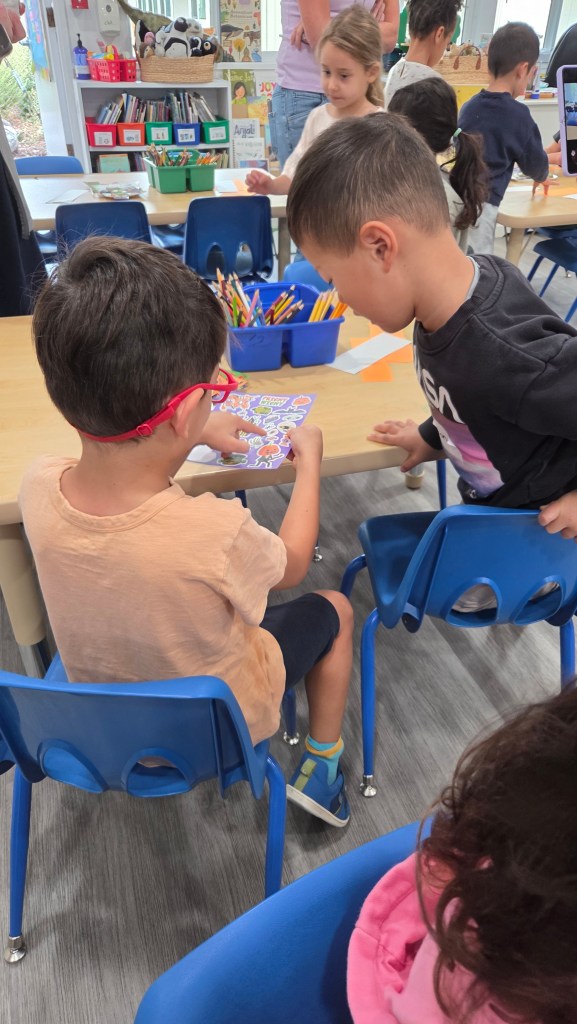
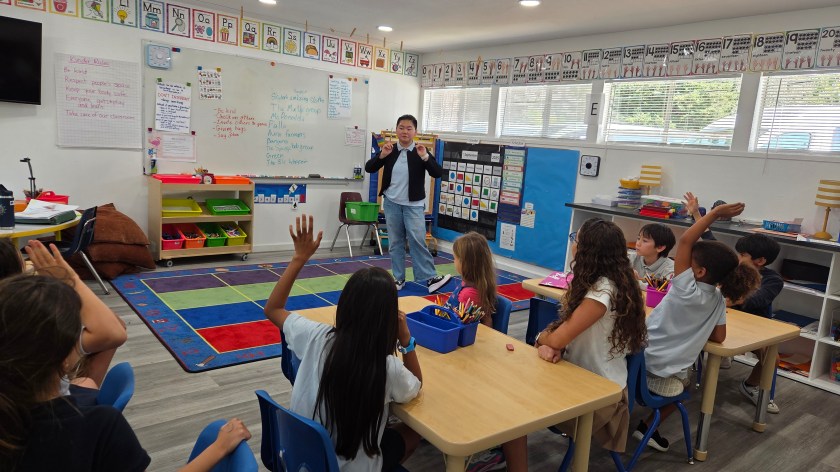
You may think that to know Maggie is to know her love of hippos– just check out how many of them her students have lovingly gifted her over the years next time you’re in the Hoot Owl classroom! But Maggie brings so much more to our ECE! Saklan is lucky to have such a dedicated, conscientious, and thoughtful Director of Early Childhood Education and lead teacher of our Pre-K Hoot Owl class. Take a moment to read about what she loves most about teaching our youngest learners.

The ECE students love to be outside, rain or shine. What do you think is the most important part of outdoor play for this age group?

Outdoor play isn’t just fun; it’s one of the most impactful parts of our students’ day. For young learners, the playground is more than just a place to run and climb—it’s where some of the most important learning happens. One of our primary goals in ECE is teaching social-emotional skills, and outdoor play is where these lessons come to life. It’s where children navigate real-life situations: negotiating over toys, practicing patience while waiting for a turn on the swing, or learning how to respond with empathy when someone gets hurt.

Outdoor play also builds confidence. We are lucky to have such a large playground, giving our students a lot of opportunities to build their gross motor skills. A favorite recent moment? One of our Owlets, who used to ask for only “medium big pushes” on the swing, now gleefully asks for “big pushes!” Moments like these show us how outdoor spaces empower children to take safe risks, try new things, and celebrate their own growth.

Whether it’s showing off a new trick on the Fire Truck or proudly calling a teacher to “come watch,” our students light up with joy and confidence as they take safe risks and master new skills on the playground. Seeing how proud of themselves the students are as they show you the amazing flip they just learned learned to do is one of my favorite parts of each day. Maintaining a safe, updated, and dynamic outdoor play space is essential to supporting these magical, everyday learning experiences.

Your newest project unit is on bugs! How does the ECE yard support learning outside of the walls of the classroom? 
In all my years of teaching early childhood, one thing has always been true—nothing captures a young child’s attention quite like a bug. They could be running in a race with each other, and the moment someone spots a bug, everything stops. Then, there will soon be a big crowd, with someone shouting “I can’t see” and trying to squeeze their way in for a closer look. With our current project on bugs, the playground has transformed into an outdoor science lab. It’s so cute watching them carefully use bug catchers and magnifying glasses to get a closer look. These moments are powerful, allowing the students to have hands-on learning experiences and explore their natural curiosity in real time.

A few years ago, we added a small raised garden with help from one of our ECE teachers and her dad. Since then, we’ve grown veggies to support various units and teach them where food comes from. We’ve seen that a garden space like this means they are more willing to try new foods when they have a hand in helping grow it. Recently, the Hoot Owls have been digging for worms and putting them in our garden bed because they learned that worms are helpful decomposers that our garden needs. The yard isn’t just a place to run and play—it’s a true extension of our classroom. It offers space to wonder, explore, experiment, and grow. Providing a dynamic outdoor environment is one of the best ways we can support their development.
What do you hope your students learn from you that you don’t explicitly teach? 

I really hope I impart my great love for hippos to my students. Just kidding! (mostly…) I hope my students learn to be able to laugh even when things get hard. I always like to joke around with my class whenever I get the opportunity. I like to joke around when I make mistakes, because I want them to learn not to be too hard on themselves. Life is about having fun and laughing with those around you. Nothing beats hearing the kids laugh because of silliness!

Each year around the mid-autumn festival you have made model mooncakes in the ECE. What are your favorite parts of bringing your traditions to the classroom and/or opening space for families and students to share theirs?

I love having families come in to share their family traditions. Even if people share the same culture, how they celebrate can be completely different. We have a wealth of experts right in our classroom to share about so many cultures and traditions, so why not take advantage?! 

When members of our community come in to share their knowledge or experiences, the classroom lights up with engagement. The students are very excited to learn from a real-life person they know! I also personally love learning about others’ traditions. Growing up, I didn’t experience that in my classroom, and if I did, it was very basic stuff. I would feel ashamed of my family’s traditions because I was different. I don’t want anyone else to feel that way. I want my class to feel love and pride for their heritage and traditions. What better way to develop that love and pride than to have their family and community members share, learn, and celebrate together?

Measuring the Earth

Eighth-grade geometry students have been busy diving deep into the world of circles. Building on their foundational skills, students used compasses to construct parallel lines, equilateral triangles, and perpendicular bisectors, setting the stage for more advanced discoveries.

Their curiosity led them to explore the properties of chords, where they quickly observed that the center of a circle lies on the perpendicular bisector of any chord. From there, their investigations expanded to include central and inscribed angles, as well as arcs, deepening their understanding of how all the parts of a circle connect.

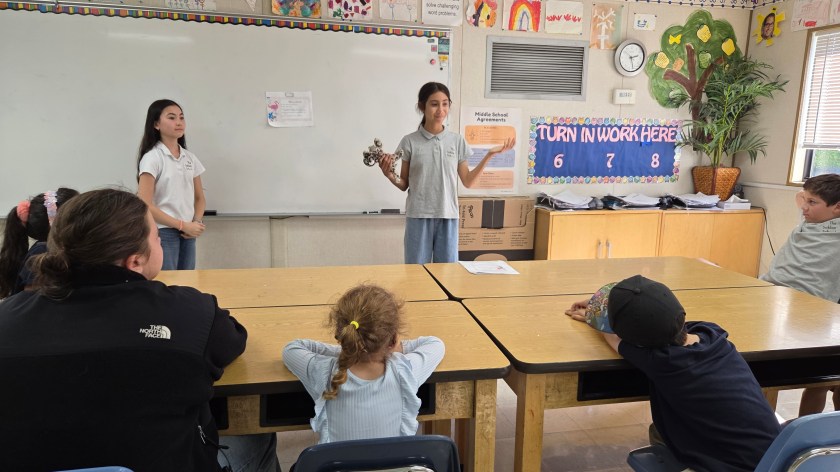
Students then took on a historical challenge by stepping into the shoes of Eratosthenes, a 3rd-century BCE mathematician who famously calculated the Earth’s circumference. By using the length of a shadow cast by a meter-long stick, just like Eratosthenes did in Syene and Alexandria, students applied proportional reasoning to calculate the Earth’s circumference, arriving at an impressive 24,869 miles!

This hands-on exploration showed just how relevant geometry can be beyond the classroom—and gave the eighth graders a meaningful connection between math and the real world.

#SaklanHandsOn

Change for a Cause

Sixth Graders Take Action to Protect Endangered Species

Over the past few weeks, the sixth graders have been learning about ecosystems in science class. They’ve gained an understanding of how organisms become dependent on each other within a healthy ecosystem and the threats that they may face. In doing so, they have learned about the loss of species through invasive species, disease, and human impact. Therefore, the students wanted to help a species in need. In groups, the students researched several species, including the Hector’s dolphin, the Pangolin, the Axolotl, and the Amur Leopard. They found out where each species is located, why they are important to their ecosystem, and what threats there are to the species.

In order to raise money to help these species, students are going to hold an election, and the entire Saklan community is invited to participate. Starting on Monday, you will see decorated buckets on the tables near the office, and you can lend your spare change to vote for the species you want to help the most.

Each cent you contribute will count as one vote. One penny will count as one vote, a quarter will count as 25 votes, a dollar will count for 100 votes, and so on. All of the money raised will go to the World Wildlife Fund, which is working to help these species.

We will collect for one week and then we will symbolically “adopt” the species that gets the most votes, and will announce the winner to the Saklan community.

#SaklanCompassionate

Internet Safety Parent Ed Event

Join us for our free Internet Safety for Kids virtual parent education workshop this Wednesday, April 23, at 6:00 p.m. During the presentation, Darryl Holcombe, one of the region’s expert law enforcement officers working to keep kids safe online, will share tips, insights, and strategies to help children stay safe when navigating the internet and social media.

This event is open to the public, so feel free to invite friends and family to attend. RSVP to receive the event link using the button below!

Cheers to 70 Years!

We are very excited for Saklan’s 70th Anniversary Gala & Auction, and hope you will join us on Saturday, April 26th, from 6:00 – 11:00 PM at Lafayette Park Hotel. This swanky, adults-only event will feature a cocktail reception, seated dinner, live auction, fund-a-need paddle raise, live music and dancing, and loads of fun! 

Wondering why you should attend?

  1. To support a great cause! Proceeds from the auction support the unique programs offered at Saklan, including: field experiences, guest experts, Project Based Learning, family groups, and professional development opportunities for our amazing teachers.
  2. To hang out with old friends and make new ones! Many Saklan parents, teachers and staff members will be in attendance. This is an opportunity to get to know fellow parents and Saklan teachers better!
  3. To bid on fantastic auction items! This year’s live auction is full of must-have items:
  4. To dress up and have an adults-only night out! Dust off your flapper dresses, fedoras, and spats, or cocktail attire from the decade of your choice, and join us for a night of fun! Signature cocktails, jazzy tunes, and a massive game of rock, paper, scissors await you!

Ticket sales close on Sunday, so don’t delay – get your tickets today!

Check out the pictures below from last year’s auction to get an idea of the fun to be had!

Summer Camp Filling Up

A summer of creative exploration awaits your child this summer during Summer@Saklan! This summer, camp will run in one-week sessions and focus on art and science, offering children the chance to have fun and learn while creating art masterpieces, engaging in exciting science experiments, playing fun games, meeting special guests, and more!

Camps are available on a first-come, first-served basis, and some sessions currently have very limited space left. Don’t delay in registering; use the button below to register your camper today!

#SummerCamp

Head’s Corner: Playgrounds that Inspire

The Evolution of Play Structures – This Year’s Fund-A-Need

As a child, my memory of play structures at school is pretty vivid. We can start with the color—predominantly metal gray. Much of the parts looked like they were taken from the hardware store plumbing aisle. During the winter, they were cold to the touch; in the heat of summer—untouchable. How many of you have a memory—seared into your bottom—of speeding down the shiny metal slide on a hot July day?

Most of all, though, they lacked space for imagination.

Play structures have undergone a significant transformation over the decades, reflecting our evolving understanding of child development. It wasn’t until the past 20 years or so that play structures moved from being prescriptive in how children were meant to use them to designs open to a child’s imagination—a place where children could direct their own experiences.

Well-designed equipment becomes a canvas for inventive play, changing its purpose to match the day’s adventure. These structures support not just physical development but also cognitive growth, social skills, and emotional resilience—all through the power of self-directed play.

This evolution reflects a broader shift in how we view childhood—moving from seeing children as passive recipients of instruction to recognizing them as active constructors of their own understanding. Today’s most innovative play structures (and educational approaches) reflect a deep respect for children’s capabilities.

Sound familiar? It should; students’ “meaning making” of what they learn is a foundational tenet of authentic Project-Based Learning.

This year’s Fund-a-Need is more than just playground equipment—it’s an investment in the kind of education we believe in. Your contribution will directly impact how our students play, learn, and grow every day at Saklan. When we give our children thoughtfully designed spaces to play, we give them the tools to become the innovative thinkers our world needs through the simple but profound act of play.

Join us in bringing this vision to life! Your support for this year’s Fund-a-Need will help create dynamic play spaces that foster creativity, collaboration, and exploration—just as we do in the classroom. Every contribution, big or small, makes a lasting impact on our students’ daily experiences. Let’s build playgrounds that inspire the next generation of innovators and problem-solvers. Donate today and be a part of shaping the future of play at Saklan!

Developing a Community of PBL Practitioners

Just like our students engage in productive struggle during Project Based Learning units, Saklan teachers improve our project curriculum through collaboration and reflection. Sometimes, this happens through informal conversations—while waiting at the copy machine or stopping by a colleague’s classroom during a prep period. At other times, our educators come together in more structured settings such as full faculty training sessions, tuning and reflection protocols for project units, and small-group Professional Learning Communities (PLCs). Below are reflections from staff on how these collaborative practices support them in developing strong, impactful PBL units for Saklan students.

Reflection protocols at the end of a unit are a great way to consider how to make a PBL unit better with help from others. They give teachers a chance to step back to look again with objectivity, just like we ask our students to do. The surprising result for me is how excited and motivated I am by this style of reflection. This collaborative approach is really motivating because it is something I could not do on my own.

– Yette Prizeman, 2nd Grade Teacher

I love the tuning protocols because having other people’s ideas helps me improve my projects immensely. Even if I feel like I have a good handle on the driving question, learning goals, project path, and products, during the discussion, things always come up that I didn’t think of. It really proves that more minds in the room means better outcomes. The process also feels very supportive and validating.

– Riva Zippin, Kindergarten Teacher

Taking part in a Professional Learning Community practice this year has made me focus on how to make group work more equitable and how to have the students own their project time. It has given me more tools to help show the students skills to help them work on their own time management. Additionally, I have enjoyed working alongside my coworkers and learning from them. Being in such a small school, it’s hard to find time for these meaningful conversations, and the PLC format allowed time for this discussion. 

– Vickie Obenchain, Science Specialist

In the ECE we work closely together on our units but not usually with Lower School or Middle School staff as much. The PLC groups help paint a clearer picture of what is happening in other classrooms and share ideas.

– Erin DeMoss, ECE Teacher

Working in a cross-divisional PLC small group focused on rubrics allowed us to imagine ways we can align rubrics across grade levels. Each year, the students can focus more on the content and less on the format of a rubric, which increases student independence and self-monitoring of learning. A format to share resources and talk together as teachers about ways to improve our assessment is door-opening. Discussions with colleagues open a new realm of understanding the experiences, successes, and hurdles of different teachers across divisions.

– Lauren Haberly, Art Specialist

These reflections highlight how a culture of collaboration and continuous improvement not only strengthens our PBL curriculum but also builds a vibrant professional community—one where educators grow together to create meaningful, student-centered learning experiences.

#SaklanPBL

Alumni Corner: Harrison Leenhouts

Harrison Leenhouts, a member of the Saklan Class of 2019, is currently a sophomore at Colby College, double majoring in Philosophy and Economics with a concentration in financial markets. He shared that he continues to rely on the core values he learned at Saklan—curiosity, courage, and community—principles that have shaped both his academic and personal growth.

At Colby, Harrison balances his studies with athletics as a recruited member of the varsity men’s lacrosse team while also staying active with the club climbing team. His interest in finance has led him to join two student-run investment clubs, where he has gained valuable real-world investing experience. Beyond academics and sports, he enjoys rock climbing, spinning pottery, and teaching himself Dari—a language he has been fascinated by for some time.

Recently, Harrison accepted an offer to join Goldman Sachs’ growth equity team in New York as a summer intern for 2026. This achievement marks the culmination of years of hard work, perseverance, and dedication, and he is thrilled for the opportunities ahead.

Reflecting on his journey, Harrison credits Saklan with helping him develop the ability to work collaboratively, stay adaptable, and push through challenges—skills that continue to serve him well today. He is grateful for the strong foundation Saklan provided and looks forward to the next chapter in his career.

We are incredibly proud of Harrison and celebrate his accomplishments, knowing he will continue to make a meaningful impact in all he pursues!

Saklan loves staying connected with our alumni and celebrating their journeys! If you or a Saklan alum in your family have an update to share, we’d love to hear it! Keep us posted on your adventures, achievements, and milestones—we’re always proud to see where life takes our graduates!

Taking on Invasive Species

As part of the sixth-grade earth science curriculum, the students learned about how pests and invasive species can affect an ecosystem. One species they focused on was the Crown of Thorns (COT) sea star. They learned how the sea star’s fast reproduction and limited predators on the Great Barrier Reef are creating quite a problem for that precious ecosystem. The COTs eat the algae in the coral, which is causing the coral to die at rapid rates. Students then learned how scientists are using Remote Operated Vehicles (ROVs) to learn to identify and inject vinegar into the COTs. The vinegar dissolves them from the inside out. These ROVs can work 24 hours a day in all kinds of weather conditions. 

Ms. O had the 6th-grade students team up to create their own ROVs. With a grant from National Geographic Education, the students were able to use SeaMate Angelfish ROVs to simulate the work of the scientists out on the reef. The students had to design a frame, add motors, learn how to work their control box, and decorate their ROV.

With the ROVs completed, the students were given the challenge of collecting COT’s from the local MCC Augusta Pool. Students had to figure out how to maneuver their ROV and remove the imitation COTs from the pool.

It was amazing to see the engineering and design process happening while the students took the role of scientists. 

#SaklanHandsOn