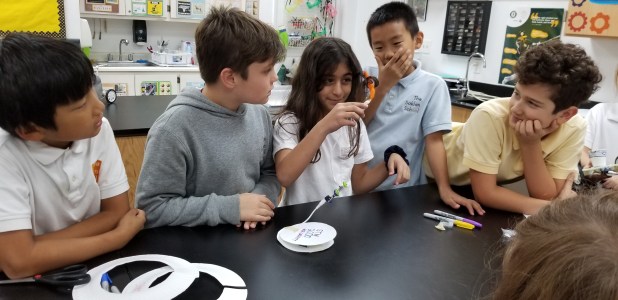
The 4th graders were in the Science lab for the last three weeks to study about electricity and currents. They learned about static and moving charges, which items are considered insulators and conductors, and built both a number of series and parallel circuits.
In conclusion to that unit, the students got to work with our new STEM kits and build their own inventions.
From Segways and vehicles to alarm clocks, hair curlers, treatment delivery systems and musical hovercrafts – it was really fun!
Students started off learning about one of the five basic senses: touch. With their eyes closed and open, they experienced different sensations in feeling textures such as fur, sand paper, felt, rubber, fake grass, etc. They described what these textures felt like and whether they enjoyed or disliked those sensations and why. After the discussion on where such textures are on this planet, they were introduced to sculpture artist Louis Nevelson.
Louise Nevelson is most known for her monochromatic (one-color) large sculptures using found objects. After looking at some of her artwork and discussing what they see through the arrangement of objects, the students were excited to build their own sculptures. They were given a variety of materials with different textures to create a sculpture that has many layers and surprises to it.
The final steps include choosing one color that will cover the entire sculpture and giving the work a title. They will revisit Louise Nevelson’s sculptures and see how she used her titles to give meaning. The final step of making will be a mini critique so their peers have an opportunity to ask questions and the artist has time to explain their artwork and process.
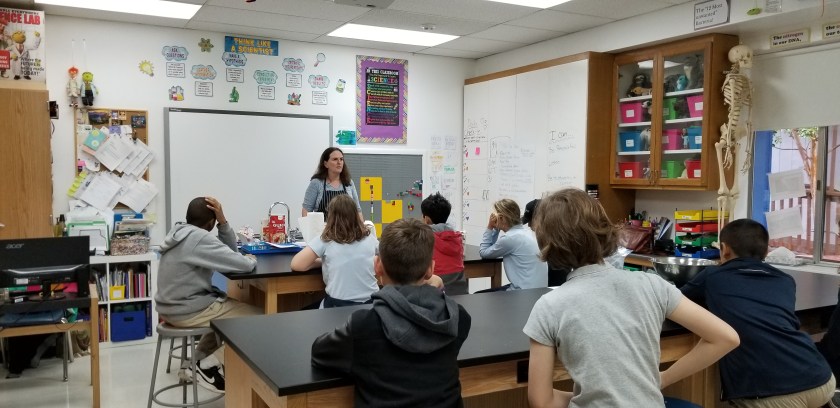
The sixth graders have been learning about nutrition in Science class. Proper nutrition is essential for maintaining good health. The students learned about each food group, daily recommendations, vitamins and minerals, essential nutrients and what they do for the human body. Our bodies need to be treated right in order for them to function correctly. This unit helps the students gain the ability to practice making better food choices in their diet and, hopefully, reducing health risks through proper diet.
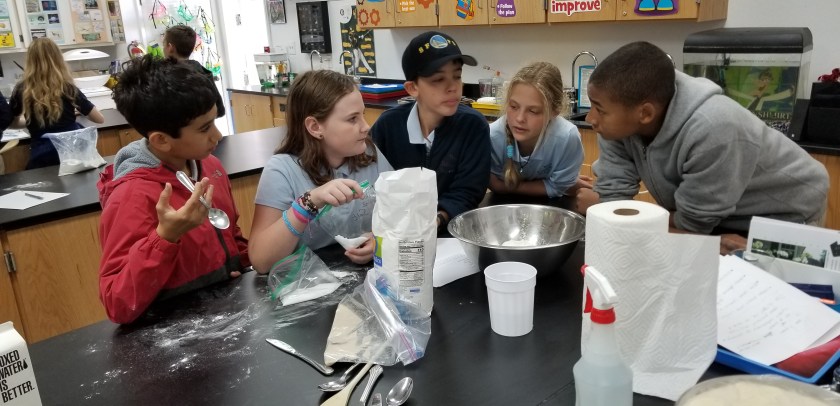
Guest expert Donna Pickthall, co-owner of Genuine Goodness cafe in Orinda and mom of Evie in 6th grade, came to the science lab to help teach the 6th graders about sugar in their food. Students got to create 3 types of bread dough with different sugar amounts to see and taste the difference. They also made healthy pizza rolls which they all enjoyed at lunch. It was a fun morning!
What can lines create? Paintings, shapes, sculpture and beyond. First, the students learn when something is flat, like a painting or drawing, it is two-dimensional. What THEY WILL CREATE pops up from the paper and you can SEE ALL THE WAY AROUND, making it SCULPTURE!
Using straight line strips of paper and glue, the Kinders create their own one of a kind standing sculpture. They learn how to make shapes, spirals, arcs, and zig zag lines all using a flat, straight line paper. The possibilities are endless to this sculpture project, as students can build on existing shapes.
Their imagination grows as they continue to build off each line of paper and relate it to something they have seen or imagined. Some students created their own sculpture garden, imagining where a person climbs and wonders. The kindergarteners showed great excitement and focus in building their line paper sculptures! Following this project, students will move onto two-dimensional line drawings and paintings.
This week, the 8th grade created hot air balloons that would help test the ideas of buoyancy and Archimedes Principle, along with Charles’ Law in Chemistry. Using paper, glue, tape and paperclips, they engineered balloons that they thought would create the largest lift when filled with heated air.
The students worked together to fill the balloon and create lift. After some on the fly design changes, and adding different amounts of air, we finally got lift off! The engineering processes was in full effect with the 8th graders, and when hitting snags in their designs, and having environmental challenges, they were able to tinker their designs and way of thinking to accomplish their goal. With the help of the wind as well, we noticed how fluids move in and push matter.
This year, the students were able to create balloons that reached a higher altitude than any other year.
“A circle is a round straight line with a hole in the middle.”
~Mark Twain~
This year The Saklan School got a brand new parachute for their physical education program! “Parachuting” is great fun and a healthy activity for students of all ages.
The parachute strengthens primarily shoulder, arm and hand muscles, and at the same time allows for practice of basic locomotor skills, such as running, leaping, skipping, and galloping. Teamwork and cooperation are essential in order to successfully complete many of the fun activities which can be created by the parachute.
Students of all grades love playing with the parachute. The non-competitive, rhythmic social interactions are a great start to a new school year.
Bienvenido a la clase de ESPAÑOL! It is well said that students with proficient multilingual and technology skills will thrive in the future.
In Spanish class this year, Saklan is integrating DESCUBRE Supersite, an online learning environment to engage students and build their confidence in learning Spanish. With this curriculum, students have a number of digital formats to practice their Spanish. This can be used in the classroom as well as at home. Learning doesn’t only happen in the classroom!
This year the Saklan West African Music program is embarking on an exciting and ambitious program. Each class is learning a different style of music from the Ewe speaking people of Ghana.
Ewe music is organized into different styles. Every style has its own set of rhythms, its own dance, and its own songs that are sung. Any one style could have countless drum patterns, choreographies or songs that are composed by master musicians. All these compositions fit within the style of music and are performed together.
The 4th grade is learning Agahu, a social dance that we performed at the Annual Spring Concert last year.
The 5th grade is studying Atsia, a social dance whose name literally means “style.”
The middle schoolers will learn a style called Tokoe which is a rite of passage dance performed by Ghanaian teenagers.
Each class will learn rhythms, choreographies and songs that belong to these styles throughout the school year. The students will improve their musicianship and build community. Saklan students also gain respect for other cultures and develop their listening skills.
Mr. Isaac teaches after school enrichment classes on Thursdays. Students can sign up for these classes if they are looking for more opportunities to learn and participate in the Saklan West African Music program.
The Saklan campus is getting a makeover! The old wall ball on the sports court is getting a fresh coat of paint that will catch everyone’s eye along the trail. The 5th-8th grade are currently working on brainstorming ideas with a powerful message and theme for the mural. They will draft drawn proposals to be given to the Art Teacher Ms. Natalie and Head of School Mr. O’Connell to decide which will ultimately become the final work of art. Once the artwork has been chosen, the whole school will help paint the mural.
A mural is any artwork that is painted on a wall. Looking back to the discovery of the Lascaux Cave paintings from the Paleolithic Era, the origin of murals provides us with knowledge that is still relevant of artists today. The inclination for artists to express themselves on any and all surfaces granted and available still exists. With muralists socially accepted and in high demand all over the world, I had to narrow down the history of murals I would teach the kids.
In the process of narrowing down content, Ms. Natalie chose Los Angeles (her hometown) and the Mission District of San Francisco. She grew up in awe of the scale and power these murals held in the City of Angels. The students will explore mural artists such as Judy Baca, Diego Rivera, the Oakland Mural Project, and community-based non-profit Precita Eyes Muralists in SF. These two regions of CA have a deep mural culture driven by social justice and providing space for people to tell the stories of history, not in the books. The painted walls provide much more than a pretty picture; they provide hope and power to the people.
The 5th grade is measuring out the mural space and finding the square footage.
The Saklan School is pleased to announce that Vickie Obenchain, Science Teacher, has been selected to attend the Nobel Teacher Summit in Stockholm Sweden this October. The Nobel Prize Teacher Summit is an international teacher conference held in Stockholm every year. Teachers from over 30 countries meet Nobel Prize Laureates, top scientists and peace activists around a theme of great importance in education. The initiative builds on the ability of the Nobel Prize to inspire people to seek out knowledge, to ask questions, and to attempt to understand and improve the world. This year’s theme is Climate Change Changes Everything.
During her week in Stockholm, Ms. O will work with some of the world’s most prominent speakers, including: Hiroshi Amano (Nobel Prize in Physics), Beatrice Fihn (Nobel Peace Prize), Mario J. Molina (Nobel Prize in Chemistry), Johan Rockström (prominent environmental scientist).
Please join us in congratulating Ms. O.
For more information about the Nobel Teacher Summit, please click here.





 The Saklan School is pleased to announce that Vickie Obenchain, Science Teacher, has been selected to attend the Nobel Teacher Summit in Stockholm Sweden this October. The Nobel Prize Teacher Summit is an international teacher conference held in Stockholm every year. Teachers from over 30 countries meet Nobel Prize Laureates, top scientists and peace activists around a theme of great importance in education. The initiative builds on the ability of the Nobel Prize to inspire people to seek out knowledge, to ask questions, and to attempt to understand and improve the world. This year’s theme is


You must be logged in to post a comment.