Mexican Folk Art

Middle School Learning by Doing Elective Class

A Cross Curriculum Elective Unit with Spanish & Art

Dia de los Muertos (Day of the Dead) originated several thousand years ago with the Aztec, Toltec, and other Nahua people, who considered mourning the dead disrespectful. For these pre-Hispanic cultures, death was a natural phase in life’s long continuum. The dead were still members of the community, kept alive in memory and spirit—and during Día de los Muertos, they temporarily returned to Earth. It takes place on November 1 and 2—All Saints’ Day and All Souls’ Day on the Catholic calendar—around the time of the fall maize harvest. It is celebrated throughout México and in recent years, has been adopted by many societies in the U.S.A.
IMG_4693

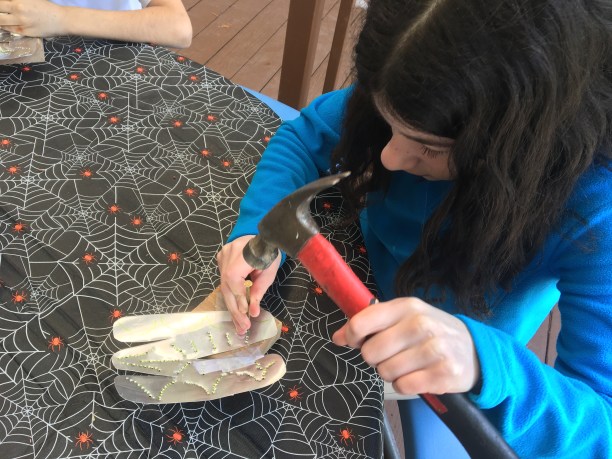
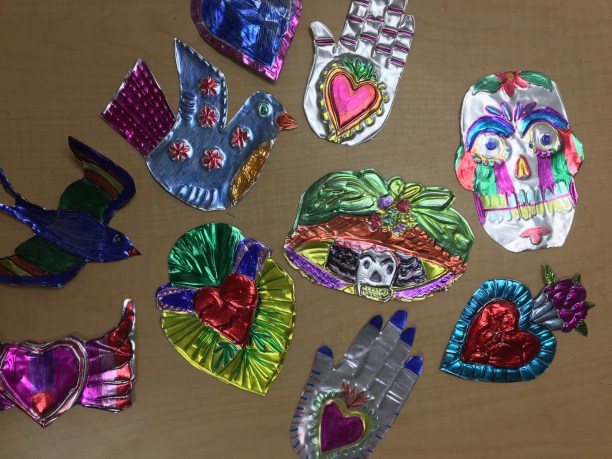
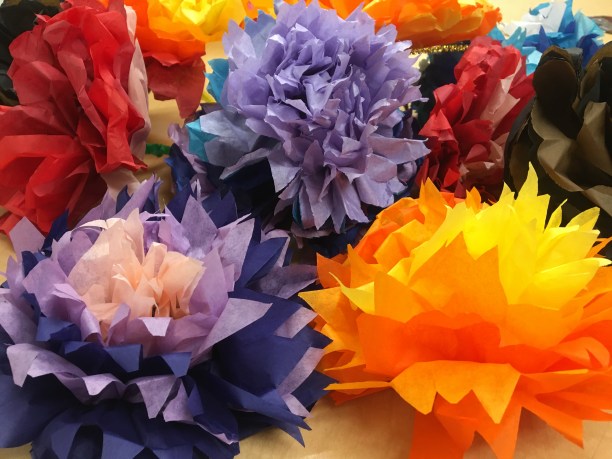
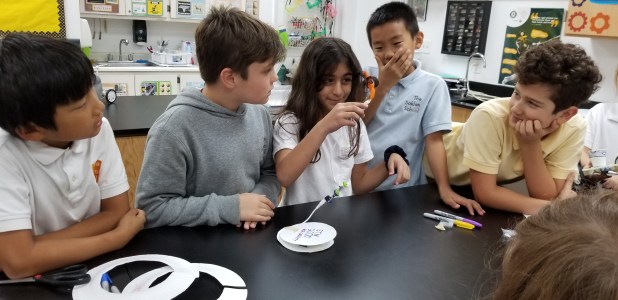
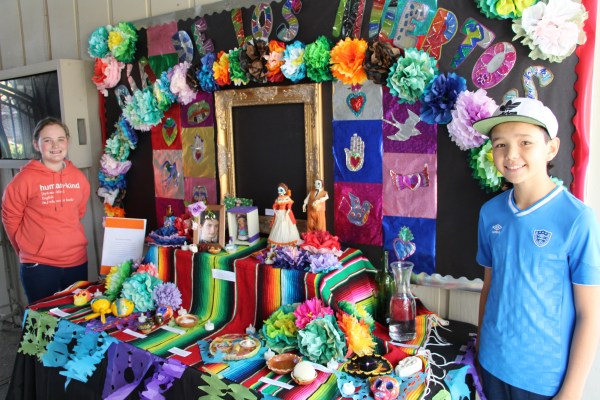
The ofrenda (offering) altar is constructed to help guide the spirits of family members back to the land of the living on the noche de muertos, the night of November 2. The altar holds all four elements- earth, wind, water, and fire. Representing the element of earth, seeds or grains are left out in bowls, while salt is left to cleanse the spirits and purify their souls during the following year. The students made all parts to the altar and learned the significance behind each of the elements. They created embossed metal folk art which is a technique that raises a 2 dimensional image into a 3 dimensional. With embossing, students craft traditional Mexican imagery that surrounds the photos of the loved ones that have passed and sit at the top of the altar. They also created the Dia de los Muertos Lettering using hammers and nails to create the raised and textured designs. They made flores de papel (tissue paper flowers) to build the Día de Los Muertos arch and papel picado (perforated paper). These perforated designs are still hand-cut in Mexico with tissue paper, making it a recognized Mexican folk art. Draped around altars and in the streets, the art represents the wind and the fragility of life.
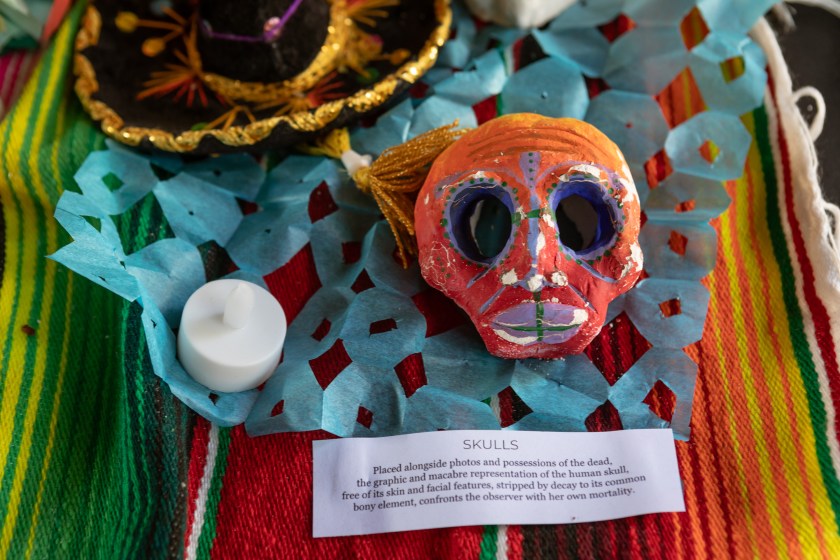
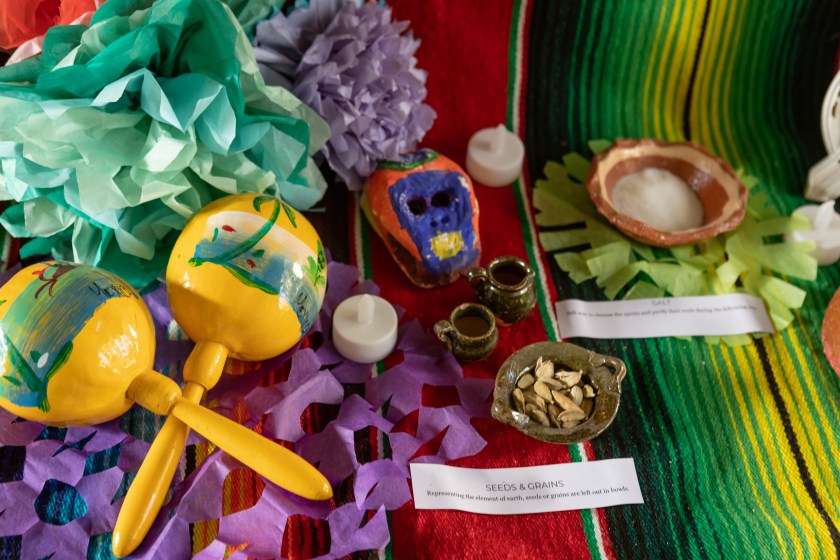
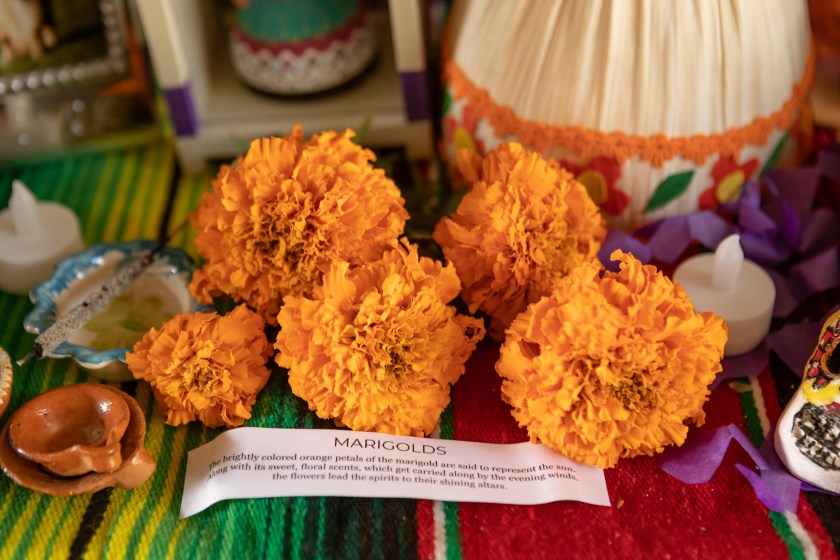
The ceramic skulls were made from past students who wanted them to be kept for the purpose of the altar every year. Placed alongside photos and possessions of the dead, the graphic representation of the human skull, confronts the observer with their own mortality. The brightly colored orange petals of the marigold flowers are said to represent the sun. Along with its sweet, floral scent, which gets carried along by the evening winds, the flowers lead the spirits to their shining altars. As twilight fades away, and family and friends gather around, the flickering lights begin to fill the nooks and recesses of the displays with a warm glow, which helps guide the dead to their altar. This is the fire element and it is believed that color, light, and strong scent of the flowers and candles can guide the souls from cemeteries to their families’ homes.
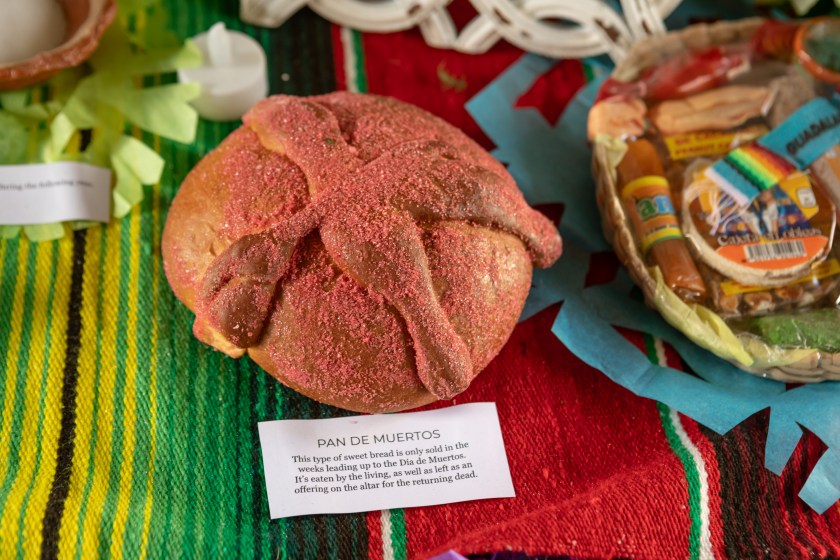
Pan de Muertos (bread of the dead) – which is a type of sweet bread that is only sold in the weeks leading up to the Día de Muertos. It’s eaten by the living, as well as left as an offering on the altar for the returning dead. The soap, a basin of water and the towel helps the spirits of the dead bathe and keep clean while they are back on earth. Pitchers of water are also left so the spirits can quench their thirst after a presumably long journey back home from the afterlife. This altar celebrates the loved ones we have lost within our community, as well as remembering and honoring those who have made an impact in our daily lives but were not directly related to us.

#SaklanWellRounded

Hopscotch?

“I’ll risk forty dollars that he can outjump a frog in Calaveras county.” –Mark Twain

hopscotch markers

When was the last time you hopped twelve times in a row, stopped, balanced on one foot, and bent down to pick a small object off the ground? If you keep repeating this dance, you are most likely involved in a “hopscotch-like” activity. The layout and rules of the game vary around the world. This ancient exercise is simple in concept yet challenging in practice.

IMG_5105

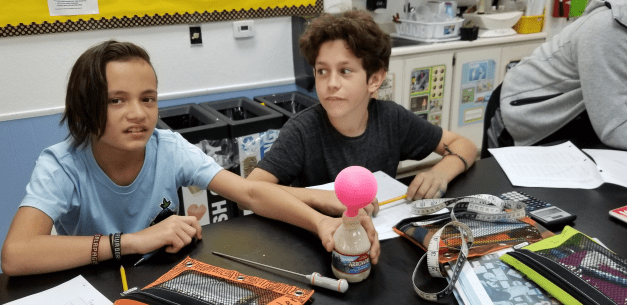
The physical education students have learned how to play a nine square variation. They have also chalked out different layouts creating their own hopping patterns. Markers have been crafted with various materials such as: paper clips, duct tape, coins, homemade bean bags, and even a deflated balloon filled with flour.

IMG_5044

Currently, the student body and faculty are competing in the Fourth Annual Fall Classic Single Elimination Hopscotch Grand Championship Friendly Intramural Tournament. Forty-eight contenders have completed qualifying matches and are set for the preliminary round. Matches take place during recesses and will continue till there is a champion. Good luck, and don’t trip!

Let’s go Saklan!

#SaklanWellRounded

Atomic Attire

The 8th grade has been learning about the periodic table. From researching what all the symbols mean to understanding what the atomic number and atomic mass tell us about each element, they are becoming more comfortable every day.

They have been working on their atomic attire shirt. Each student picked one element they wanted to get to know more about. They designed a shirt for it to show off and model for you all. While our 8th graders are still figuring out what they want to be, some may have the skills to be runway models! Click below to check out their video.

#SaklanCreative

Dry Ice Experiment

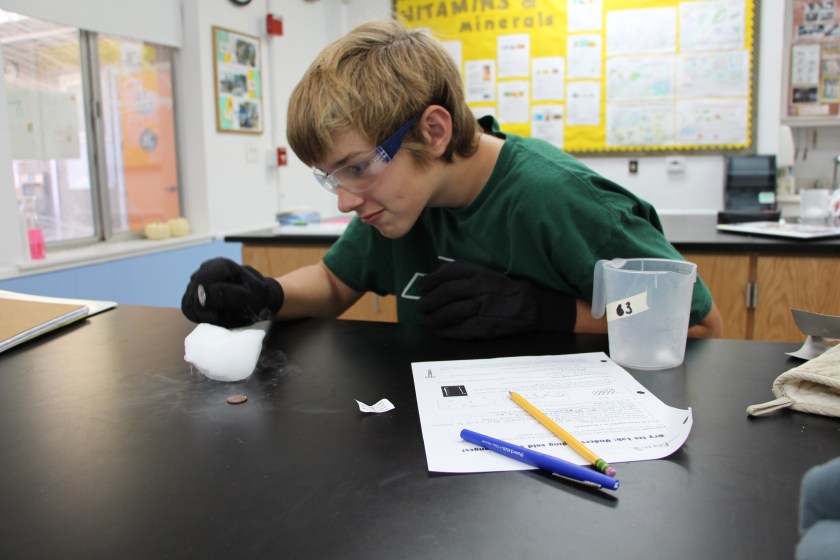
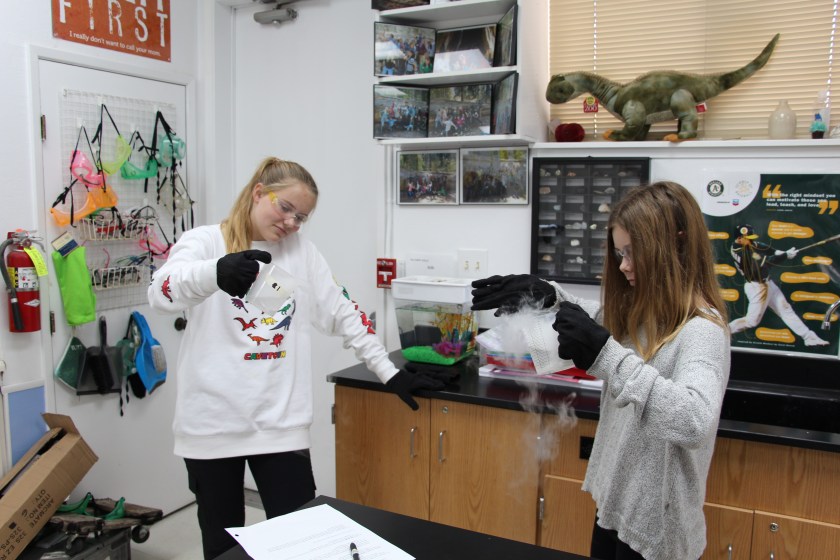
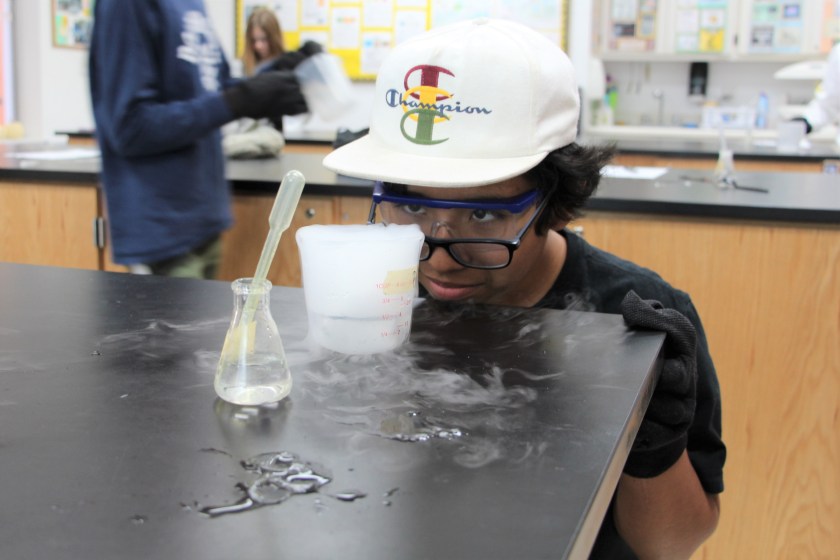
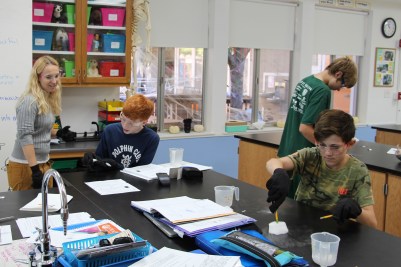
8th grade is in the middle of their chemistry unit. They have been learning about the periodic table and different properties of these elements. This week, the 8th grade was looking at boiling and freezing points. It’s hard to imagine a liquid oxygen molecule or a solid gas since we are used to living at a comfortable climate. So to understand this, students investigated dry ice or frozen carbon dioxide. At a cool -109 degrees F (approximately) and the classroom at a temperature of 68 degrees F, this drastic temperature change creates a sublimation state change for the dry ice; it changes straight from a solid to a gaseous form.

Students began to understand how the quick change creates a dense gas or fog coming off the dry ice. This dense air sank and created a bubble of air the students could use to float the block on top of the counter. They pushed pennies into the block to see how matter responds at that temperature and how solid gases react to warmer solids colliding into them. By adding water to the block, they saw the water bubble (boil) with white gas filled bubbles and then freeze the water they had once put over the dry ice.

IMG_4232a

They then related their understanding of what was happening in our solar system. As frozen gases orbit through space, when they come close to stars, they melt, much like our dry ice was doing on the table, and produce a gaseous tail. We recognize these orbiting frozen gas balls as comets.

#SaklanHandsOn

Mexican Folk Art

IMG_1365

The Day of the Dead or Día de los Muertos is a Mexican holiday celebrated throughout México and, in recent years, it has been adopted by the U.S. On this day, families and friends come together to honor those who have passed and help support their spiritual journey.

IMG_1517

The students learned about the Mexican folk art called “hojalatería y pintura.” They created embossed metal folk art – a technique that raises a 2-dimensional image into 3-dimensional. With embossing, students crafted traditional Mexican imagery.

IMG_1518

They also made flores de papel china (tissue paper flowers) to decorate the arch for Día de Los Muertos. It is believed that the strong scent of the colorful flowers can guide the souls from cemeteries to their family homes.

#SaklanCreative

El Corazon del Pueblo

Second and third graders have been learning about Día de los Muertos or Day of the Dead in Spanish class. Day of the Dead is a Mexican holiday where families welcome back the souls of their deceased relatives for a brief reunion that includes food, drink and celebration. A blend of Mesoamerican ritual, European religion and Spanish culture, the holiday is celebrated each year on November 1-2. This holiday involves family and friends gathering to pray for and remember friends and family members who have died, and helping support their spiritual journey. In Mexican culture, death is viewed as a natural part of the human cycle. Mexicans view it not as a day of sadness but as a day of celebration because their loved ones awake and celebrate with them. In 2008, the tradition was inscribed in the Representative List of the Intangible Cultural Heritage of Humanity by UNESCO.

Traditions connected with the holiday include building private altars called ofrendas, honoring the deceased using calaveras, Aztec marigolds, and the favorite foods and beverages of the departed, and visiting graves with these as gifts. Visitors also leave possessions of the deceased at the graves.

Sugar skulls represent a departed soul, it has the name written on the forehead and is placed on the home ofrenda or gravestone to honor the return of a particular spirit. Sugar skull art reflects the folk art style of big happy smiles, colorful icing and sparkly tin and glittery adornments.

Last week, second and third graders went on a field experience to El Corazon de Pueblo in Oakland to make sugar skulls. Students were very excited to learn how to make the dough for sugar skulls, put them in molds and then decorate them with colorful icing.

#SaklanExperiential

Introduction to the Cell

pasted image 0-1

Biology this year starts off with understanding the basic building block of life, the cell. Seventh graders learn all the cell parts, discover plant cells and animal cells (their own cheeks) under a microscope, and then they learn how a membrane works. Students also learn why we produce carbon dioxide through cellular respiration and plants use that to produce oxygen in photosynthesis.

pasted image 0

Students have discovered this through hands-on labs – seeing iodine move across a membrane to turn corn starch black by modeling diffusion and seeing a balloon fill up with carbon dioxide as yeast cells perform cellular respiration. All these functions are vital to a cell’s survival. 

#SaklanHandsOn

Middle School Music Ensembles

Screen Shot 2019-10-01 at 12.43.17 PM

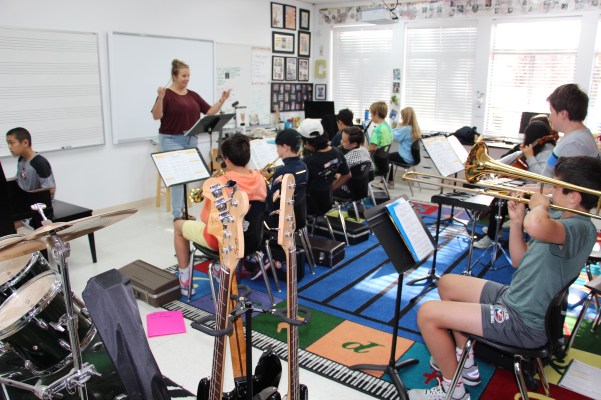
As the first month of school winds down, the middle school music ensembles are beginning to ramp up the energy, and are diving deep into technical concepts and tonal flexibility.

IMG_3065.JPG

The Band class is beginning to work on expanding their focus and ability to read notes on a page, and extending their range. The Orchestra is finishing a tonal and rhythmic review, and the Choir is in the midst of basic sight singing using moveable “do”. They are also working on the Beatles piece Let It Be., and a Choral Mix from Hamilton.

IMG_3947

Philosophically, students are really focusing on the way their unique abilities and talents contribute to the ensemble, and discovering that the way they play and practice directly affects others around them. We are beginning to discover that we fly or fall together, and that in order to succeed, every person needs to be a part of play. As our philosophies and brains change, it is incredibly exciting to see the beginnings of true musicians.

#SaklanWellRounded

INKtober 2019

Inktober

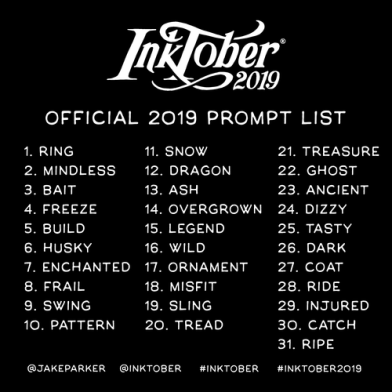
It’s that time of year again! It’s INKtober! Every day for the month of October, students 5th-8th have a homework challenge to create a drawing based upon a word of inspiration. INKtober was started by artist Jake Parker in 2009 and has become more popular every year. Jake wanted to develop his drawing skills and create good working habits.

Inktober is for students to become more comfortable, confident, and creative with drawing. They are to draw for at least 10 minutes a day and can color in their drawings if they choose. They can choose a theme like Halloween or challenge themselves to draw something they find hard, like people or hands. A lot of great work comes from this project every year! You can participate with your kids, too!

#SaklanCreative

4th Grade Inventions

20190927_143504

The 4th graders were in the Science lab for the last three weeks to study about electricity and currents. They learned about static and moving charges, which items are considered insulators and conductors, and built both a number of series and parallel circuits.

In conclusion to that unit, the students got to work with our new STEM kits and build their own inventions.

From Segways and vehicles to alarm clocks, hair curlers, treatment delivery systems and musical hovercrafts – it was really fun!

#saklanhandson