News From The Sports Court

“The greater the obstacle, the more glory in overcoming it.”
– Molière

DSCF8342

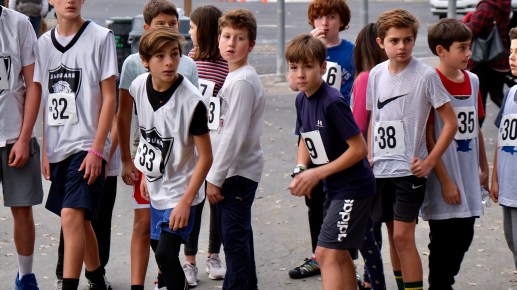
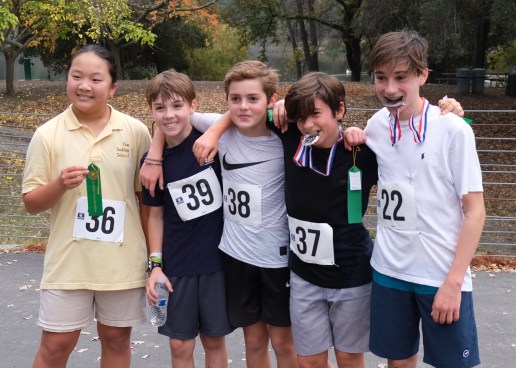
One of the core tenets of The Saklan School is courage. Five Saklan students took a risk and ran a foot race against peers from other schools around the Lafayette Reservoir.  This cross country event was grueling. The distance around the lake is about 2.5 miles with a lot of up and down terrain.

DSCF8404

Last Tuesday evening was the Fourth Annual Cross Country Invitational Meet. The Saklan School usually finishes well at this event and this year’s race was the fastest yet. A special shout-out to: Mac, Nick, Phoebe, Reese, and Thomas for completing this challenging adventure.

Let’s go Saklan!

#SaklanWellRounded

6th Grade Builds Volcanoes

20191122_132443-e1575656207322.jpg

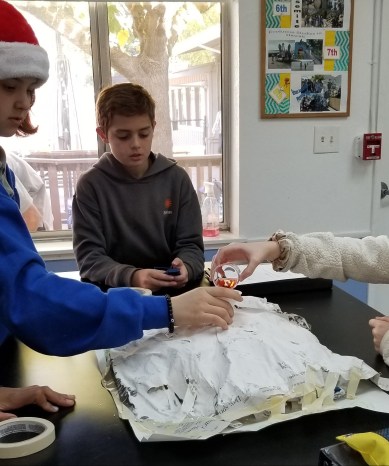
The 6th grade has been learning about different types of volcanoes and their parts, where they are located, what type of eruptions occur, dangers and advantages of living by active volcanoes and how they create different rocks and formations. Students looked at different types of igneous rocks, tested different fluid viscosity to see how different lavas might flow, and then built their own shield volcano and tested off different batches of “magma.” They determined the speed of flow, what minerals make the lava flow slower and how those different flows cool into different rocks.

After they learned about historic volcanoes and ones we still might want to be concerned about. It was a lot of fun!

#SaklanWellRounded

Can You Hula Hoop?

IMG_1854

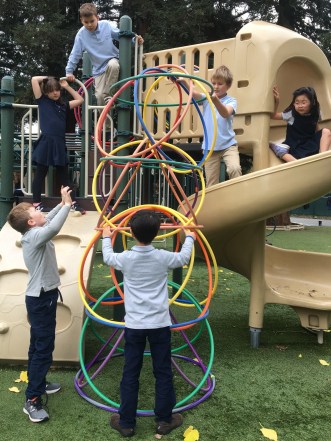
The physical education students have been practicing with hula hoops since the beginning of the year. Did you know that you can build with the hula hoops? Six hoops can be stacked to create a stand alone structure.

image-3

The Saklan students didn’t stop with six. During recess, a few ambitious builders have begun to stack the structures. The builders are looking for different locations which will allow them to reach greater heights. The tower is growing to four and five stories! Today, the students broke the record with four stories and this structure will go down in Saklan history!

Let’s go Saklan!

#SaklanWellRounded

Mixing Magic Color Wheels

IMG_1810

The Kindergarten is learning about the color wheel! Using Model Magic, the students mixed their own secondary colors (Orange, Green, Purple) using equal parts of the primary colors (Red, Yellow, Blue). They enjoyed mixing the colors with their hands and seeing the magic happen right before their eyes! In this exercise, students can create a wide range of colors fairly quickly and understand the amount of each color it takes to create others. While the model magic is still soft, they can break off a little of one and another color to make more colors like yellow-orange, blue-purple, green-blue, etc. (More yellow than orange will make yellow-orange, more blue than green will make blue-green, etc.)

Students were sent home with their model magic color wheels to play with color mixing! This is the most non-messy and tactile way of learning how to mix colors, not to mention the cool sculptures they can make with this material. If the model magic is left out and not placed back in the bag, IT WILL DRY OUT! So make a fun sculpture before it hardens! Here is just one idea: if the kids mix many colors they can attach all spheres to make a caterpillar!

In the following weeks, students will read from The Day the Crayons Quit by Oliver Jeffers to create their own story and artwork behind their favorite color of the color wheel.

#SaklanCreative

¿Que Tiempo Hace Hoy?

IMG_5444

Second graders meet for Spanish class 3 times a week for 30 minutes each time. The Spanish courses are taught with an emphasis on interactive activities, stories, poems, songs, and games that are used to introduce vocabulary and commonly used phrases in Spanish. Students also engage in art projects to help them draw associations to the Spanish material as they speak and create. Reinforcement and repetition are used to help retain material.

This past week, students were introduced to vocabulary associated with different seasons and weather. They learned the name of the four seasons in Spanish: el invierno, la primavera, el verano and el otono. The four seasons is a fun topic because there is so much to talk about. First, the students discussed the characteristics of each season. Then, they shared their favorite season and why they liked it. They also created a “dado” (dice) with the different weather types and they asked each other questions such as “¿Que tiempo hace hoy?” (How’s the weather?). These activities gave the second graders lots of opportunities to practice their Spanish.

#SaklanWellRounded

Kindergarten – Tree of Life

Tree of Life
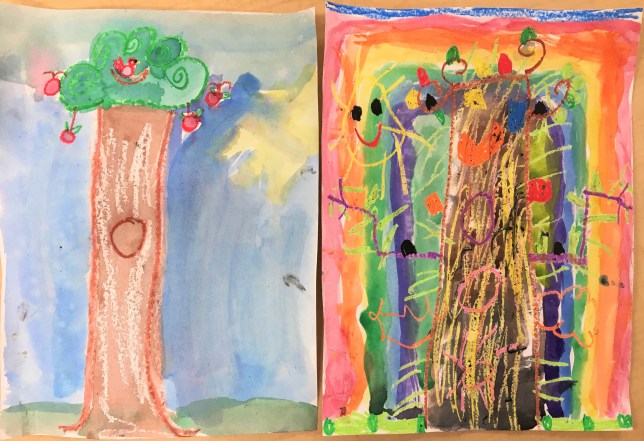
Misheel Javkhlangerel Tree of Love                              Sage Avant Tree of Love

Students have been working with chalk, oil pastels, and watercolor resist techniques in the Art Room. The students had a one day project for them to take home and the inspiration came from Gustav Klimt’s painting, The Tree of Life. The Kinders titled their artwork after explaining what their own tree represented.

The Tree of Life reaches up into the sky and down into the earth. It represents strength, protection, mother nature, wisdom, and beauty. The swirly branches keep your eye wandering and exploring the details in the painting. Using lines to make up the tree, students used oil pastels first and then water colored the whole paper to reveal the resist technique. This creates beautiful results that the students are proud of creating!

#SaklanCreative

Understanding The 5-D Process

pasted image 0-1

The 7th grade has been continuing their use of variables to represent an unknown number in a variety of contexts. In this chapter Mr. Zippin introduced the 5D Process as a new method to solve problems that our previous methods were too challenging or too time consuming to solve. In the 5D Process, the students carefully read the problem and write the important parts and relevant information in the Describe part. This is also the place where they could draw a picture if that would be helpful to solve for the unknown.

pasted image 0-2

The second D is the Define columns where the students carefully label the elements of the problem and define what they will be guessing. Mr. Zippin stresses that the columns must be carefully labeled and filled in with full math operations. The Do column is the place where they write out the full mathematical expression. The Decide column of their table is where the seventh graders check their answer with what they are trying to find and then decide what a good next guess would be. Finally, they end with a Declare that answers the question being asked by the problem.

pasted image 0-3

As they continue to use the 5D Process, they begin to add an additional line to our table, the variable. The students begin to recognize that the variable expression can be used to summarize the relationships in the 5D process. As they continue with the work, the seventh graders will write full single variable equations and solve them from words problems.

#SaklanAcademic

Mexican Folk Art

Middle School Learning by Doing Elective Class

A Cross Curriculum Elective Unit with Spanish & Art

Dia de los Muertos (Day of the Dead) originated several thousand years ago with the Aztec, Toltec, and other Nahua people, who considered mourning the dead disrespectful. For these pre-Hispanic cultures, death was a natural phase in life’s long continuum. The dead were still members of the community, kept alive in memory and spirit—and during Día de los Muertos, they temporarily returned to Earth. It takes place on November 1 and 2—All Saints’ Day and All Souls’ Day on the Catholic calendar—around the time of the fall maize harvest. It is celebrated throughout México and in recent years, has been adopted by many societies in the U.S.A.
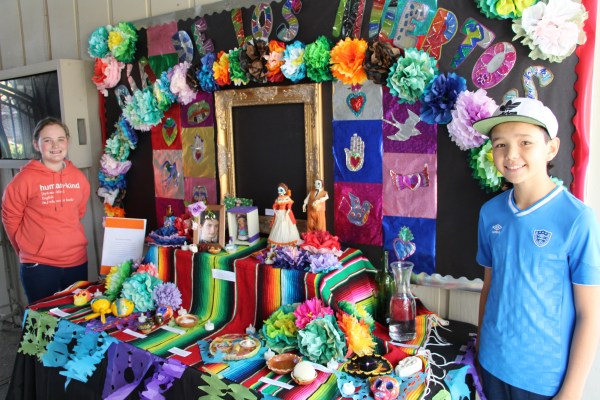
IMG_4693

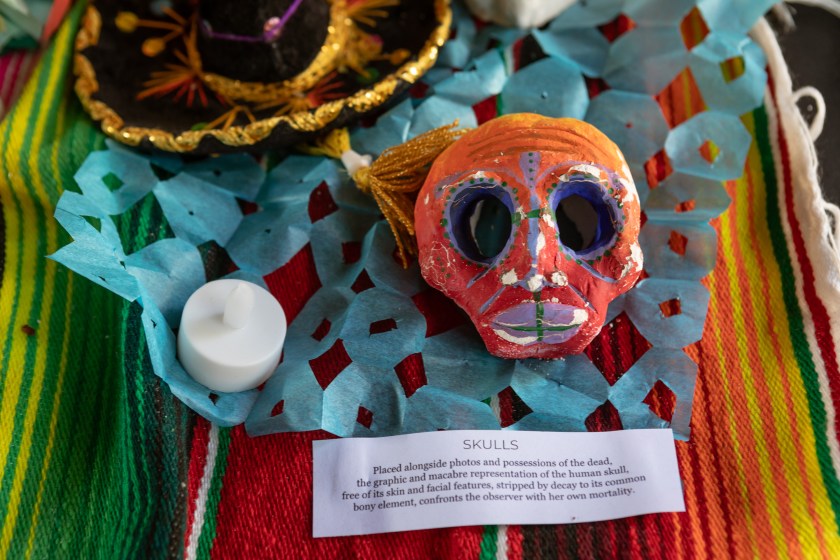
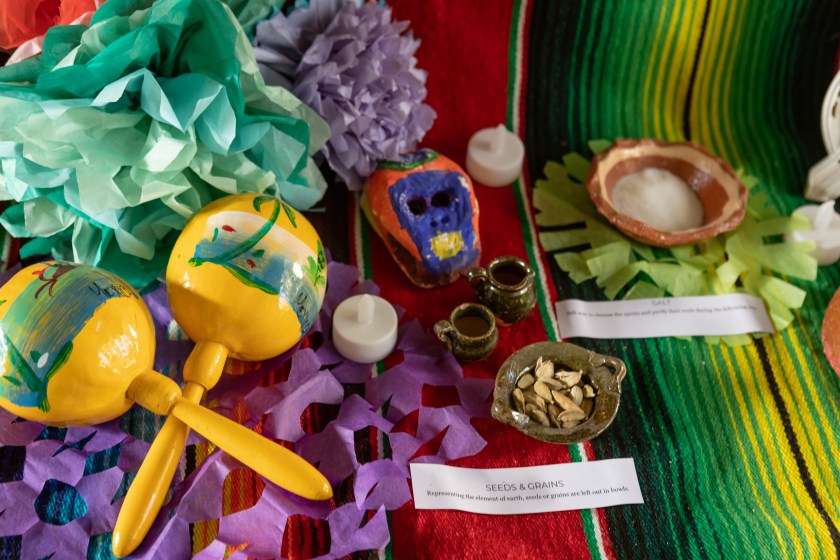
The ofrenda (offering) altar is constructed to help guide the spirits of family members back to the land of the living on the noche de muertos, the night of November 2. The altar holds all four elements- earth, wind, water, and fire. Representing the element of earth, seeds or grains are left out in bowls, while salt is left to cleanse the spirits and purify their souls during the following year. The students made all parts to the altar and learned the significance behind each of the elements. They created embossed metal folk art which is a technique that raises a 2 dimensional image into a 3 dimensional. With embossing, students craft traditional Mexican imagery that surrounds the photos of the loved ones that have passed and sit at the top of the altar. They also created the Dia de los Muertos Lettering using hammers and nails to create the raised and textured designs. They made flores de papel (tissue paper flowers) to build the Día de Los Muertos arch and papel picado (perforated paper). These perforated designs are still hand-cut in Mexico with tissue paper, making it a recognized Mexican folk art. Draped around altars and in the streets, the art represents the wind and the fragility of life.

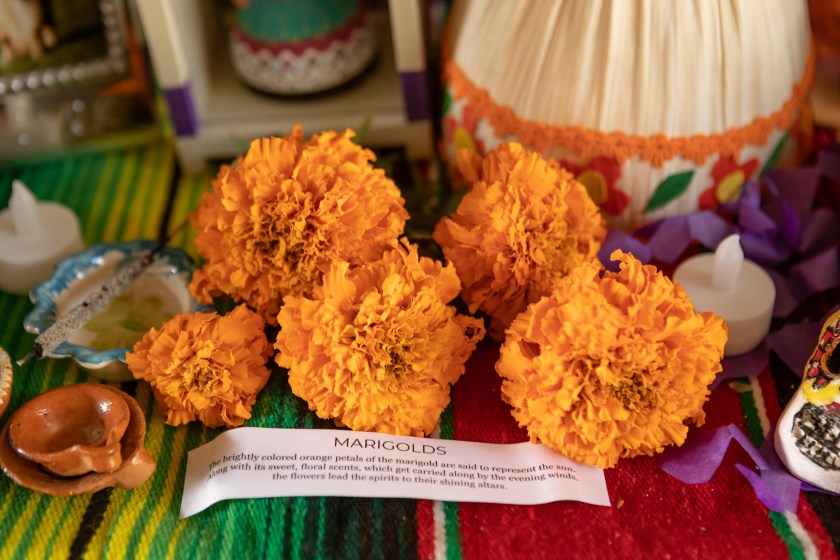
The ceramic skulls were made from past students who wanted them to be kept for the purpose of the altar every year. Placed alongside photos and possessions of the dead, the graphic representation of the human skull, confronts the observer with their own mortality. The brightly colored orange petals of the marigold flowers are said to represent the sun. Along with its sweet, floral scent, which gets carried along by the evening winds, the flowers lead the spirits to their shining altars. As twilight fades away, and family and friends gather around, the flickering lights begin to fill the nooks and recesses of the displays with a warm glow, which helps guide the dead to their altar. This is the fire element and it is believed that color, light, and strong scent of the flowers and candles can guide the souls from cemeteries to their families’ homes.

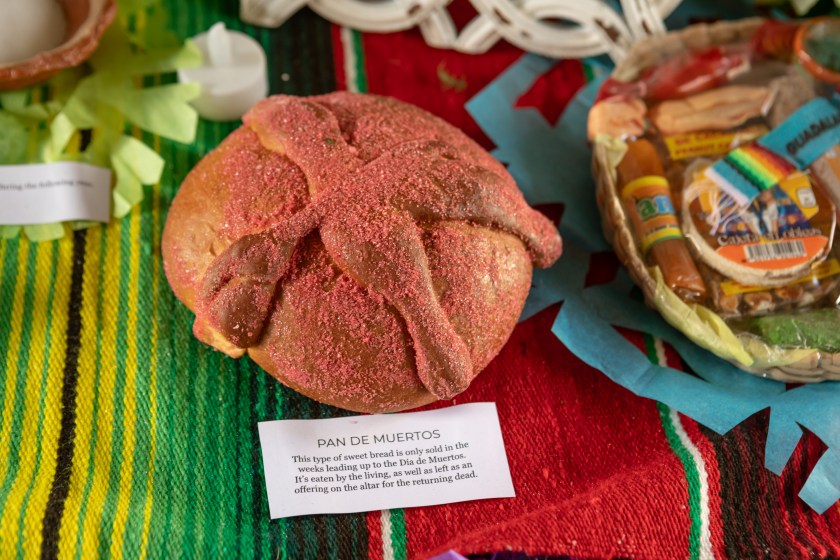
Pan de Muertos (bread of the dead) – which is a type of sweet bread that is only sold in the weeks leading up to the Día de Muertos. It’s eaten by the living, as well as left as an offering on the altar for the returning dead. The soap, a basin of water and the towel helps the spirits of the dead bathe and keep clean while they are back on earth. Pitchers of water are also left so the spirits can quench their thirst after a presumably long journey back home from the afterlife. This altar celebrates the loved ones we have lost within our community, as well as remembering and honoring those who have made an impact in our daily lives but were not directly related to us.

#SaklanWellRounded

Hopscotch?

“I’ll risk forty dollars that he can outjump a frog in Calaveras county.” –Mark Twain

hopscotch markers

When was the last time you hopped twelve times in a row, stopped, balanced on one foot, and bent down to pick a small object off the ground? If you keep repeating this dance, you are most likely involved in a “hopscotch-like” activity. The layout and rules of the game vary around the world. This ancient exercise is simple in concept yet challenging in practice.

IMG_5105

The physical education students have learned how to play a nine square variation. They have also chalked out different layouts creating their own hopping patterns. Markers have been crafted with various materials such as: paper clips, duct tape, coins, homemade bean bags, and even a deflated balloon filled with flour.

IMG_5044

Currently, the student body and faculty are competing in the Fourth Annual Fall Classic Single Elimination Hopscotch Grand Championship Friendly Intramural Tournament. Forty-eight contenders have completed qualifying matches and are set for the preliminary round. Matches take place during recesses and will continue till there is a champion. Good luck, and don’t trip!

Let’s go Saklan!

#SaklanWellRounded
Atomic Attire

The 8th grade has been learning about the periodic table. From researching what all the symbols mean to understanding what the atomic number and atomic mass tell us about each element, they are becoming more comfortable every day.

They have been working on their atomic attire shirt. Each student picked one element they wanted to get to know more about. They designed a shirt for it to show off and model for you all. While our 8th graders are still figuring out what they want to be, some may have the skills to be runway models! Click below to check out their video.

#SaklanCreative