Saklan Movie Night

All members of the Saklan community are invited to join the PA on Sunday, January 28th from 3:00 – 5:00 p.m. in the Founders Auditorium at the Orinda Community Center for a movie night!

Popcorn will be provided for all attendees. Please bring your reusable water bottle with you, as well as nut-free snacks, blankets, chairs, beanbags, pillows, or other items to get cozy (limited folding chair seating will be available).

#SaklanCommunity

The Irony of Fall Follies

Fol·ly /ˈfälē/ noun – A lack of good sense; foolishness

It appears to me that our annual Fall Follies is somewhat mischaracterized by its name, for it is anything but folly. In reality, the entire production fully embodies our mission to Think Creatively, Act Compassionately, and Live Courageously.

Creativity radiated through many of the acts, from Elise, Airlie, and Cassy’s restaurant comedy skit to the Hula Hooping of Cam and Adora. The execution of Aliya, Rebecca, Haley and Kylie’s dad jokes was not just creative, but spot on.

Compassion was on display by the audience as students summoned their courage to perform. It wasn’t just compassion, but there was an energy of encouragement, a tangible sense of “you can do this.” Performers encouraged, supported, and uplifted their fellow cast members. One of my favorite parts of the show (besides my daughters) was when Eli momentarily froze in his “How to Draw a Crocodile” act. Not only was the audience supportively patient, but I could hear students gently whisper, “Go, Eli.” That moment embodied so much of what Saklan is about.

And then there’s the courage. Stepping onto the stage in front of 250 people, spanning from peers to parents and grandparents, is no small feat.  All of the acts were displays of courage and bravery and deserve a shout out. 

While it’s unlikely that we’ll consider renaming our Fall Follies, it’s clear that the event is the antithesis of folly.

#SaklanCreativity #SaklanCompassion #SaklanCourage

The Studio Habits of Mind

As the K-8 art teacher, there’s a lot of variation in my day. One class period I’m singing a song about how to make green, another I’m teaching 3-point perspective drawing. One thing that stays consistent throughout the day, however, is my philosophy that an artist is largely made in how they make their art, not just in the quality of what they are making. To support this mindset in my classroom, I use something called “The Studio Habits of Mind.”

The Studio Habits of Mind is a research-based framework that helps students navigate the many steps and routines of the creative process. The Studio Habits were developed through Harvard’s Project Zero in the early 2000’s. Lois Hetland and a team of researchers studied the habits of practicing artists and high school art students and identified eight Studio Habits which include: Develop Craft, Engage & Persist, Envision, Express, Observe, Reflect, Stretch & Explore and Understand the Art World. They found that these habits help artists improve their art skills, problem solve, and provide concrete language for the thinking process that happens during art making. 

Something I love about the Studio Habits is how universal they are across grade levels and subjects. Kindergarten is currently learning to Understand the Art World by studying how artists show feelings in their artwork without using words. Middle schoolers are also deepening their understanding of the art world through looking at how Surrealist artists used linear perspective to create mysterious and sometimes impossible spaces. Students can develop their craft of singing in music class, engage and persist on a challenging problem in math class, or stretch and explore different ways to throw and catch a ball in PE. Studio Habits create a universal language of learning that can be used by anyone in any environment. 

Most importantly, the more that I weave the Studio Habits into my teaching, the more I have seen a shift in how students define success. Maybe they’re still working on their craft mixing the perfect shade of green, or drawing a tree-house in 2-point perspective, but they can leave the classroom feeling proud that they stretched themselves to try something new, and engaged and persisted, even when things were hard. 

Scientific Sketches

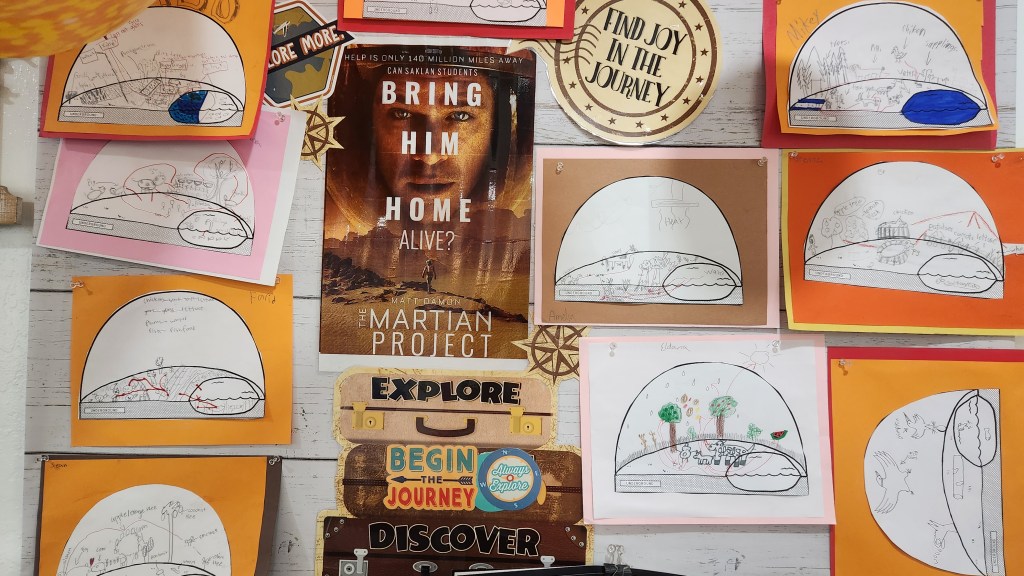
The third graders have been learning about how to sketch scientifically! 

Scientists use sketches to capture information for themselves and communicate information to others. They often sketch when they are doing field research, observing a plant or animal they cannot take back to the lab. A scientist sketches to record and communicate information. Along with a drawing, a scientific sketch often includes labels and diagrams, questions and explanations. 

You don’t have to be an artist to create a successful scientific sketch. You simply have to take time, observe closely, and record what you see. Recording what you see is different from drawing the picture you have in your head. Many of us have cartoon-like images in our head of trees, flowers, houses, apples, rabbits, etc. When you set out to sketch a real thing, it’s important to focus on the individual specimen in front of you, rather than the generalized image you carry in your head. 

Students learned the criteria for a successful scientific sketch through the mnemonic: ABCDE

Scientific sketches should be: Accurate, BIG, Colorful, Detailed, Explained.

The third graders then used their careful observation skills and practiced sketching a redwood leaf like a scientist. They have also been applying these strategies in art class recently in drawing birds. These important skills will be implemented in the art portion of their current Saklan/Bay Miwok PBL unit. 

Arepas

Each country in the Spanish-speaking world has a distinct comfort food. Colombians consider arepas their bread, which is part of their daily life and an essential part of their culture. The sixth graders had previously watched the movie Encanto and loved it! When Maestra Ivonne saw the movie, the meaningful scene where Mirabel is healed by eating one of her mother’s homemade arepas stood out to her. Therefore, she was inspired to share with the students a glimpse of Colombian culture, which is another Spanish-speaking country.  

The sixth graders made their own cheese arepas following the directions Maestra Ivonne gave them in Spanish. They combined cornmeal with warm water and used their hands to make dough (masa). They divided the masa into 3 or 4 patties using both hands to ensure the disks were uniform. Then, students cooked the arepas for 5 to 6 minutes on each side or until nice and brown. Finally, they removed the arepas from the heat to add guacamole, which the sixth graders had made fresh that day in class.

The sixth graders enjoyed their arepas and are fantastic chefs!

Deep Dive into Construction

November and December have been exciting months for the Owlets, who have been immersed in the fascinating world of construction!

The Owlets read If I Build A School by Chris Van Dusen to begin the project. From the book they learned that with the right planning and materials you can make any type of building! Since then, our Owlet architects have been busy at school working together as a community to build a lot of interesting buildings.

They built with styrofoam, marshmallows, and pool noodles together as a class, and noticed that when they used toothpicks the materials were easier to stick together. This was also fun because when they were done with one building, they could easily take it apart and build it again!

The Owlets also learned that we can’t make buildings without tools! The Owlets have been enthusiastically learning about the many uses of different tools. To learn about tools, they played a fun game of Tool Bingo! This helped them learn the names of the tools and become more familiar with what they look like.

After they had a good idea of the different tools used in construction, the Owlets were very excited to welcome their first guest expert of the unit, Mr. Javi! Mr. Javi showed the Owlets some really cool tools like a level, hammer and nails, and screws. But the Owlets were even more impressed when he showed them the blueprint to our school! He shared that an architect designs a blueprint before the carpenters begin building the structure. 

David let the Owlets borrow a big binder that was filled with more blueprints of our school! It was interesting to take a closer look at our school’s building; the Owlets were able to point out different parts of the school that they recognized.

With a great understanding of what blueprints are, the Owlets designed their own buildings using a pencil, graph paper and a ruler, just like real architects!

Another important aspect of construction is safety! On a construction site, safety gear like a bright yellow vest, hardhats, gloves, boots and safety goggles are important, as is signage. The Owlets decided to put up signs around their classroom and playground to help others practice being safe too. The students had fun picking out where to put the signs! If you are around the Owlet classroom or walking through their yard, look around to see if you can spot their signs!

Some Owlets worked together to make different types of safety clothing! Some friends made a vest, while others made boots and safety goggles.

Watch this space for more insights into the Owlet Construction Project Unit, or join them for their unit Culmination on Wednesday, December 13th at 8:40 a.m.!

#SaklanProjectWork

Kind Owls

The Hoot Owls and Owlets have been learning about kindness. The Hoot Owls read Have You Filled a Bucket Today? by Carol McCloud and David Messing. The book taught the owls that we all carry invisible buckets; when people are kind to us or when we are kind to other people, we fill their buckets as well as our own. However, when they are not kind, it dips into their bucket. The Hoot Owls all agreed to focus on being bucket fillers. They started their own kindness jar in their classroom to serve as their classroom bucket. When teachers or a friend sees a kind act, they write a slip and fill the jar. 

The Hoot Owls and Owlets read A Little Spot of Kindness and A Little Respectful Spot to learn more about kindness. The students discovered that kindness spots are part of happiness spots. Happiness occurs when one is confident, kind, respectful and loving. Being respectful is a big part of kindness. The classes talked about different ways they can be kind and then drew pictures to represent them.

The Hoot Owls and Owlets created kindness trees in their classrooms. You may have noticed the Hoot Owl tree blooming on their door, while the Owlet tree grows on their white board. The Hoot Owls painted hearts, then wrote down ways they can be kind or kind acts they have seen amongst classmates on the hearts. The Owlets are noted acts of kindness on hearts and added them to their tree.

Having physical representations around the classrooms serve as reminders to be kind. They also get the students excited to see their jar becoming full and our trees continuously growing.

#SaklanSEL #SaklanCompassion

Extraordinary Support

Thank you, Saklan, for your extraordinary support of this year’s Annual Giving Fund (AGF) campaign.

Our goals for this year’s campaign are to raise $175,000 and have 100% participation from the Saklan community. To date, we have raised over $157,000 with participation from 88% of our community (a record for this time of the year at Saklan). The chart below shows you where each class is towards reaching the 100% participation goal.

The outpouring of support from the Saklan community this year is humbling and will make a powerful impact on our ability to continue challenging students to think creatively, act compassionately, and live courageously.

If you haven’t had the chance to donate to our AGF campaign, it’s not too late! You can make an AGF gift via the following methods:

  • DONATE ONLINE through our secure site; or
  • Write your check made out to The Saklan School with “Annual Giving Fund” written on the Memo line and deliver it to our office.

If you would like to discuss your gift further, please contact Emily at ewilliamson@saklan.org.

On behalf of all of us at The Saklan School, thank you very much for your support.

#SaklanCompassionate #SaklanAGF

Holiday Food Drive

The Student Council is hosting a food drive in support of Monument Crisis Center, a community-based, non-profit family resource center serving Central and East Contra Costa County.

To ensure a well-rounded selection of food, the Student Council is asking for students in the following grades to focus on the items listed below, however, you may donate any food item on the list.

OwletsVEGETABLES – Canned or Boxed
Hoot OwlsPEANUT BUTTER
KindergartenCEREAL
1st GradeTUNA
2nd GradeFRUIT – Canned or Boxed
3rd GradeMAC & CHEESE
4th GradePASTA
5th GradeSOUPS
6th GradeOATMEAL
7th GradeBEANS
8th GradeRICE

Please, no glass containers, and make sure all items are not yet expired or past their best by date. Donations can be placed in bins in individual classrooms.

Thank you for showing compassion to our local community!

A big thank you to the Student Council for organizing this Food Drive.

#SaklanCompassion

Winter 2024 Enrichment

As the fall session of enrichment comes to an end, we are excited to share the classes that will be offered during the second half of the year! For the winter session the following classes will be available:

Check out the class descriptions here. Classes begin the week of January 22nd, and have limited space available. Registration for the classes will open on Monday, December 4th on the Saklan Enrichment Webpage.