Head’s Corner

Growing Our Students

As many of you know, middle school students at Saklan facilitate their own conferences. As I visited some of those “student-led conferences” yesterday, I started to think about my own experience as a child and the importance of student empowerment. When my parents went to conferences, I would wait at home feeling powerless about my own education. Once they arrived home, they would share with me what the teacher said, I would then present my point of view with what I thought were missing facts. What resulted was a disconnect between teacher, parent, and student.

Conferences

There were three important constituencies in this conversation, but one (me) was never represented except as a third party, a sidebar to the conversation. I missed a critical chance to talk about what was going well for me, what I was struggling with or hear their perception of what they saw at home or at school. Most importantly, I was not given the opportunity to openly reflect on my own experience as a learner.

Whether a student is doing a student-led conference or not, it is important for us to remember during conference time that the student is our most important partner. One of our main goals should be to help them develop a growth mindset through feedback and reflection. This teaches them that learning is a continual process, and it encourages them to take responsibility for their education.

So as we digest the information collected during conferences, let’s make sure to grab the opportunity to help our students, self-reflect, adjust and grow.

Warm regards,

David

Fifth Grade Trip to Sacramento

IMG_2810

Fifth graders traveled to Sacramento to learn more about the California State Capitol Museum.

Students went on a docent led tour of the building. This capitol building was the fifth. The building had been moved five times in the first four years. The Senate Chamber was very interesting.

Students were able to see the senators desks that were built in the 1860’s and are still used today.

In addition, the docent explained how a bill becomes a law in California. And that anyone can come up with the idea for a bill and submit it to their representative. One of the most important concepts they learned was that “We the People” are where the true power sits.

Jazz in the Classroom

Grades 6-8th in Green Block are learning about Jazz music and creating their own record album cover. They learned about the history of Jazz in America and the artists responsible for the album covers.

The music department loaned us a real record player! So we have been listening to musicians such as Miles Davis and Louis Armstrong while creating our own album covers! The last part of the project the students are currently working on, focuses on writing their own song using a little bit of alliteration.

Me and My Community

This slideshow requires JavaScript.

First grade students have been learning about communities. One of their topics was producers and consumers. They went to Safeway to take a peek of the products in a grocery store. They saw how some of them are made and met people who provide services and deliver fresh goods in stores in our community. They had a great time!

Save the Bees and Buterflies!

This year the third grade will be looking after the butterfly and bee gardens that our students helped to design last year during Earth day.
They helped plant flowers that will help our local populations, and will care for them throughout the year; watering and weeding when necessary.
All is welcomed to come see the gardens behind the science lab and get your photo taken as a butterfly or bee!

Circus Fun in Kindergarten

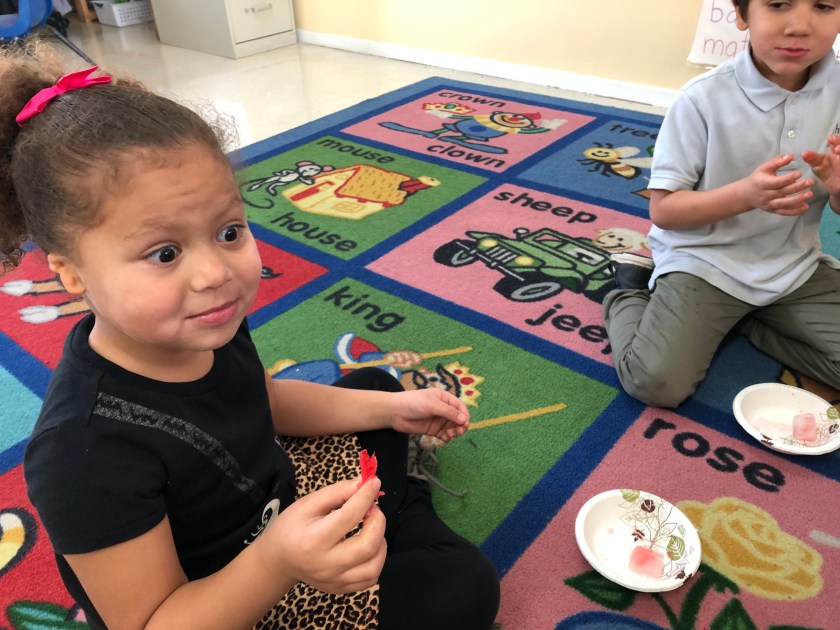
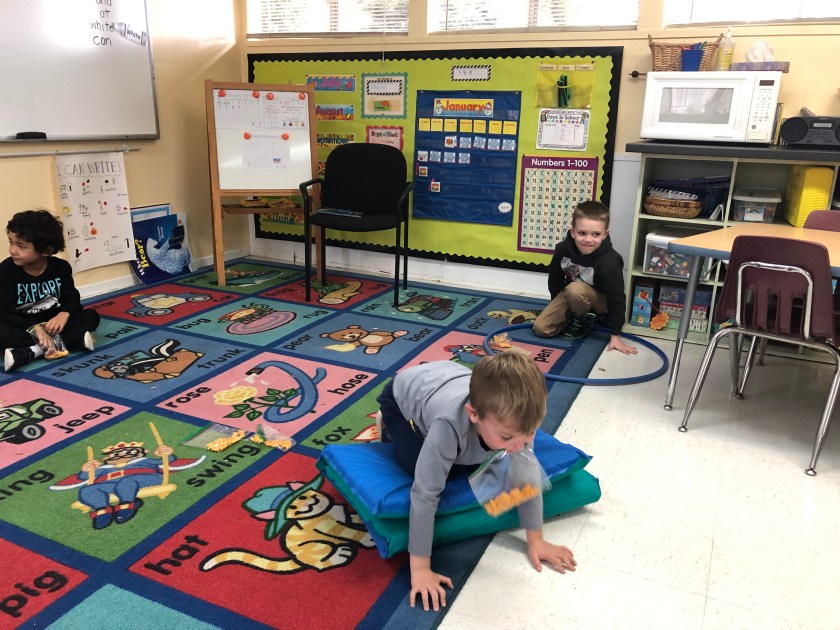
September’s theme in Kindergarten was ”Circus.” A circus theme was a great way to introduce colors and shapes. Kindergartners had fun making tents, clowns, circus animals and reading stories about the circus. They also played circus BINGO.

One PE class, Mr. Crabtree taught the children how to juggle. Yesterday, the children put on their own circus with tricks, “animal” acts, and a special clown treat.

Their last circus event was to read the story, Twenty-One Elephants and Still Standing, about the Brooklyn Bridge and Phineas T. Barnum of Barnum and Bailey Circus. This book is the introduction to bridge building which they will be studying in October.

Native American Conversations

The 8th grade Humanities class kicked off the school year with a dynamic, collaborative learning experience: Native American Conversations. The objectives of this weeklong project were multifold: 1) practice personal responsibility and critical-thinking skills; 2) practice cooperation/participation and teaching skills; 3) explore a wide range of Native American “fascinating facts” across 500+ years of history; 4) ask questions, make inferences, and develop a multiple-perspective understanding of Native American cultures in North America; 5) personalize and aim to put into real-world action what was learned.

Native American Booklet Cover pic-page-001

The students first partnered up in four “expert” groups to critically analyze four distinct sections of information. Each section included a range of topics, from “Young People Then & Now” to “Diverse Languages” to “Native American Creativity” to “2016 Dakota Access Pipeline Water Protection Protest.” The students worked together in their expert groups to ensure individual understanding of the material by reading closely, taking notes, asking questions, sharing ideas, and making connections (i.e., “big picture” inferences). After this research period within the context of the expert groups, the students split into “jigsaw” groups, which comprised experts from each group. Here’s a visual (each letter represents a student): Expert Groups: AAAA, BBBB, CCCC, DDDD. Jigsaw Groups: ABCD, ABCD, ABCD, ABCD.

Each student then assumed the role of teacher. So all the A’s taught everyone in their jigsaw group what they learned about the “A” topics. The B’s did the same, and so on. In this way, all of the students had to take on the challenge of being both teacher and student—and everyone was responsible for engaging with every single topic.

After each teach-in, the students wrote reflections to articulate what they learned (observations/information/inferences), how they learned (self-analysis of how their brains connected the info and ideas), and what they’re now going to (try to) do in their personal lives with what they learned. These takeaways are where you can really see the impact of what you’re bringing into the classroom.

Here are some standouts: 1) “I will now be more resourceful and less wasteful with what I have to show more respect for the Earth.” 2) “I will now be more grateful for everything that I have.” 3) “I will stand up for what I believe in and vote when I’m able to.”

This project is an ideal introductory activity to get the students comfortable with the expectations and responsibilities of 8th grade Humanities. It brings them together as a class and demonstrates the power of solidarity. It’s also a perfect intro to the Cultural Geography Project, which is already challenging—and rewarding!—the kids in similar ways. Onward…

Qué Hora Es?

Es la una en punto.  OR  Son las dos en punto.


Telling time on an analog clock is a very important skill and can be very useful in your daily life or if you are planning to visit a Spanish speaking country. Clocks can help you wake up in time for school, tell you when it’s time for lunch, and alert you when your favorite TV show is about to come on. Learning how to tell time can be fun when you use games, so 4th and 5th graders made paper plate clocks and practiced setting the clock hands on the right time.


Using hands-on activities in the classroom is an essential part of a child’s learning experience. Allowing students to learn while participating in an exciting activity is very motivating for children in the classroom. Hands-on activities in Spanish give students the opportunity to get involved and interact with one another.

Geography: The Next Frontier?

In 6th and 7th grade Humanities class, students are working on world geography. As many of you know, Americans are notoriously bad at remembering landmarks in the United States or identifying African countries. These are just a few examples of what students struggle with when answering questions about geography. I have included a link to an article that discusses students’ knowledge of geography throughout the world, but it definitely focuses on American students

unnamed-1

Our goal this year is that Saklan middle school students will be in that small percentage of kids that will know basic, yet important, world geography. Also, our world is becoming increasingly small due to technology. Isn’t it reasonable to expect our students to know the location of most countries in the world? As we see it, understanding world geography is a proactive step into the next frontier of learning and educating our students for a global work environment.

Currently, the 6th graders are learning all 52 of the African countries. And, the 7th graders are studying the 42 European countries. Each world region will be chosen to enhance and support our students’ knowledge in relation to their topic of study.

Remembering September 11, 2001

6th grade with sign

In 6th grade Humanities class, students have been studying the events of 9/11/01 by watching a DVD called “What We Saw.” This film was produced by CBS News. Dan Rather, a retired news anchor, narrates bits of important news coverage from 9/11 and the rescue efforts made in the following days. September 11, 2011 is the second attack on American soil, the first being Pearl Harbor. Many students know very little about the actual event because it did not happen in their lifetime. In order to understand the massive impact that 9/11 had on America and the world, students wrote questions, interviewed an adult that experienced 9/11, and typed up a one-two page response on what they learned. Below are the questions students were assigned in order to solidify the most important aspects of the project:

  • What did you learn from the interview process?
  • How did this particular perspective add to your knowledge or view of history or of the event?
  • In what ways was your interviewee biased or not? Why?
  • How do you think the world has changed since 9/11/01?
  • How has the interview made you feel about the event? The United States? Other countries?

We are fortunate that Mr. Greg Ruppert, an 8th grade student’s father, was one of the lead FBI investigators on researching the financial funding of the 9/11 terrorists. He is coming to speak to Saklan’s sixth and seventh grade classes on Monday, October 1 from 12:45-1:45 pm. Parents are invited to come see Greg speak about his experience in following the technological money trail and how this helped catch some of the responsible parties.  Please send an email to kparks@saklan.org if you are interested in attending Greg’s presentation.