
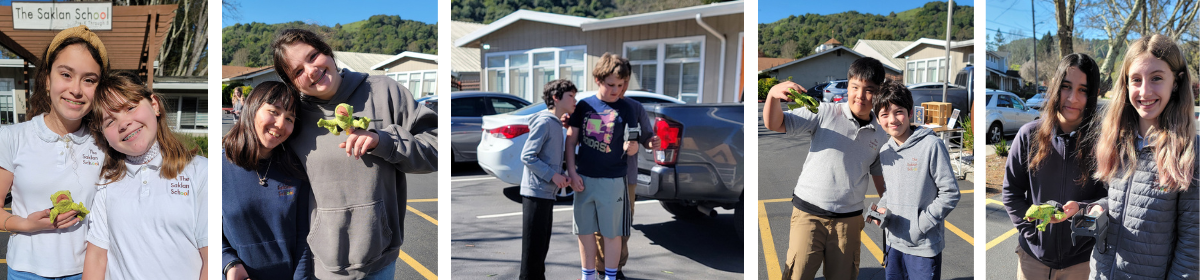
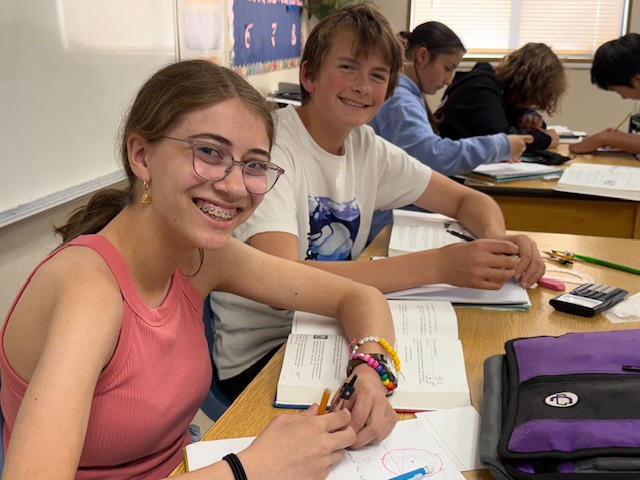
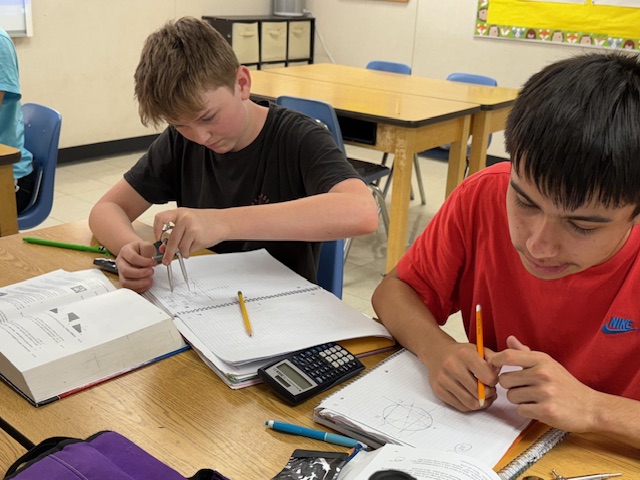
Eighth-grade geometry students have been busy diving deep into the world of circles. Building on their foundational skills, students used compasses to construct parallel lines, equilateral triangles, and perpendicular bisectors, setting the stage for more advanced discoveries.
Their curiosity led them to explore the properties of chords, where they quickly observed that the center of a circle lies on the perpendicular bisector of any chord. From there, their investigations expanded to include central and inscribed angles, as well as arcs, deepening their understanding of how all the parts of a circle connect.
Students then took on a historical challenge by stepping into the shoes of Eratosthenes, a 3rd-century BCE mathematician who famously calculated the Earth’s circumference. By using the length of a shadow cast by a meter-long stick, just like Eratosthenes did in Syene and Alexandria, students applied proportional reasoning to calculate the Earth’s circumference, arriving at an impressive 24,869 miles!
This hands-on exploration showed just how relevant geometry can be beyond the classroom—and gave the eighth graders a meaningful connection between math and the real world.
#SaklanHandsOn

 FRIDAY BLOG